Implementation Report: Multi-species Action Plan for Mount Revelstoke National Park of Canada and Glacier National Park of Canada (2017-2022)

Long description for cover image
The cover page is a series of 6 photos arranged in clockwise order. The first (from the top right) is a photograph of the Illecillewaet Glacier viewed from Avalanche Crest in Glacier National Park. There is dry grass in the fore-ground and a stormy sky in the background. To the left of the glacier, you can see a large talus field with many boulders below a tall cliff. The second photograph is a close-up image of a researcher holding a very small Little Brown Myotis (Myotis lucifugus) with one hand. The bat is shown in profile and it has large ears, small eyes and fuzzy fur. The bat's mouth is slightly open. The third image is of Whitebark Pine (Pinus albicaulis) regeneration in an area where a fire has previously burned. There is a small seedling surrounded by weathered tree trunks. The fourth photograph shows Park staff using a drip torch to ignite dry fuels at a prescribed fire in Mount Revelstoke National Park. The staff member is wearing a uniform, helmet, ear protection and large gloves to protect them from the fire. They are pouring fuel from the drip torch onto the pile of leaves as it lights up into flames. The background is forest understory. The fifth photograph is of 5 Woodland Caribou (Southern mountain populations) (Rangifer tarandus caribou) standing on a snowy slope. The caribou are contrasted by the stark, white of the snow. You can clearly see the caribou's shadows and long shadows stretching in from trees outside the photo frame. There is a small conifer tree in the top of the photo. The sixth photo is of a Park staff standing at the entrance of an ice-cave in the Illecillewaet Glacier. The staff member appears very small in comparison to the scale of the glacier. They are wearing a jacket, hat, pants and mitts. There are large chunks of ice at their feet. The glacier ice is covered in patterns of ripples, bumps, and ridges. The scene is illuminated from the back where sunlight is entering the cave.
On this page
- Preface
- Acknowledgments
- Executive Summary
- 1. Context
- 2. Implementation of the action plan
- 3. Action plan highlights
- 4. Ecological impacts
- 5. Socio-economic impacts
- Appendix A. Technical Compendium – Population and Distribution Objectives
Document information
Recommended citation:
Parks Canada Agency. 2022. Implementation Report: Multi-species Action Plan for Mount Revelstoke and Glacier National Parks of Canada (2017 – 2022). Species at Risk Act Action Plan Report Series. Parks Canada Agency, Ottawa. v + 27 pp.
For copies of the report, or for additional information on species at risk, including the Committee on the Status of Endangered Wildlife in Canada (COSEWIC) Status Reports, residence descriptions, recovery strategies, action plans and other related recovery documents, please visit the please visit the Species At Risk Public RegistryFootnote 1.
All photos, unless otherwise stipulated are copyright of Parks Canada.
Photo credits:
Cover (listed clockwise from top right): Illecillewaet Glacier from Avalanche Crest in Glacier National Park, R. Buchanan; Little Brown Myotis, M. Kellner; Whitebark Pine regeneration, R. Buchanan; A drip torch is used to ignite dry fuels at a prescribed fire in Mount Revelstoke National Park, I. Houghton; Caribou in snow, R. Buchanan; Person touching glacier in Glacier National Park, R. Buchanan.
This page: Moss campion on Mount Hennessey in Glacier National Park, R. Buchanan; Page i: A collared Woodland Caribou mother and calf feed as part of the Revelstoke Caribou Rearing in the Wild project, R. Buchanan; Page ii: Moss-covered Western red cedars at the Giant Cedars Boardwalk in Mount Revelstoke National Park, R. Buchanan; Page iii: A Woodland Caribou calf feeds under its mother's watchful eye, R. Buchanan; Page 1 (from left to right): Staff member standing on trail, S. Bird; Woodland Caribou, R. Buchanan; Little Brown Myotis, A. Froschauer, USFWS; Staff member with rainbow, A. Jung; Prairie Hills, A. Jung; Staff member viewing Flat Creek prescribed fire, N. Stafl; Staff member doing field work, Z. Lynch; Jade Pass, H. Waterous; Staff in helicopter, Z. Lynch; Glacier, R. Buchanan; Page 14 (clockwise from top right): Whitebark Pine seedling, I. Reid; Fire crew work on the Grizzly Ridge prescribed fire using a heli-torch, S. Hunt; Park staff collect Whitebark Pine scion, I. Reid; Page 15: Two Woodland Caribou navigate snowy, high elevation slopes in Glacier National Park, Ministry of Forests, Lands, and Natural Resource Operations; Page 19: Hiker admiring an old-growth tree in Mount Revelstoke National Park, R. Buchanan; Page 20: Hermit Meadows in Glacier National Park, R. Schmidt; Page 21: Park staff working on Mount St. Cyr in Mount Revelstoke National Park, H. Waterous.
Également disponible en français sous le titre:
« Rapport de mise en œuvre : Plan d’action visant des espèces multiples dans les parcs nationaux du Canada du Mont-Revelstoke et des Glaciers (2017-2022) »
© His Majesty the King in Right of Canada, represented by the Minister of the Environment and Climate Change, 2022. All rights reserved.
ISBN 978-0-660-46399-5
Catalogue no. CW69-21/45-1-2022E-PDF
Content (excluding the illustrations) may be used without permission, with appropriate credit to the source.
Preface
The federal, provincial, and territorial government signatories under the Accord for the Protection of Species at Risk (1996)Footnote 2 agreed to establish complementary legislation and programs that provide for effective protection of species at risk throughout Canada. Under the Species at Risk Act (S.C. 2002, c.29) (SARA), action plans outline measures that will be taken to implement recovery strategies for SARA-listed Extirpated, Endangered and Threatened species. Parks Canada's multi-species action plans address a suite of species of conservation concern within one or more Parks Canada managed areas, including species that require an action plan under SARA.
The Minister responsible for the Parks Canada Agency (the Minister of the Environment and Climate Change) is the competent minister under SARA for the species found in Mount Revelstoke National Park of Canada and Glacier National Park of Canada, and in 2017 published the Multi-species Action Plan for Mount Revelstoke National Park of Canada and Glacier National Park of Canada.
Under section 55 of SARA, the competent minister must monitor the implementation of an action plan and the progress towards meeting its objectives, and assess and report on its implementation and its ecological and socio-economic impacts five years after the plan comes into effect. A copy of the report must be included in the Species at Risk Public Registry. The Minister responsible for the Parks Canada Agency has prepared this Implementation Report: Multi-species Action Plan for Mount Revelstoke National Park of Canada and Glacier National Park of Canada (2017-2022).
The achievement of population and distribution objectives identified within the recovery strategy or management plan for a species may require a long time frame. In these cases, a five-year reporting window may not be sufficient to show demonstrable progress towards meeting site-based population and distribution objectives identified for that species within a Parks Canada site-based action plan. Parks Canada monitors, evaluates and, as necessary, adapts measures taken to achieve species survival or recovery, and will report on progress towards meeting site-based population and distribution objectives every five years.
Acknowledgments
Parks Canada would also like to acknowledge all staff, partners, stakeholders, neighbours, volunteers and researchers who have contributed to implementation of the Multi-species Action Plan for Mount Revelstoke National Park of Canada and Glacier National Park of Canada.
Executive Summary
This document reports on the implementation of the Multi-species Action Plan for Mount Revelstoke National Park of Canada and Glacier National Park of Canada between 2017 and 2022. It reports on implementation of measures identified in the plan, assesses progress towards meeting site-based population and distribution objectives, and evaluates socio-economic impacts.
Species addressedFootnote 3,Footnote 4
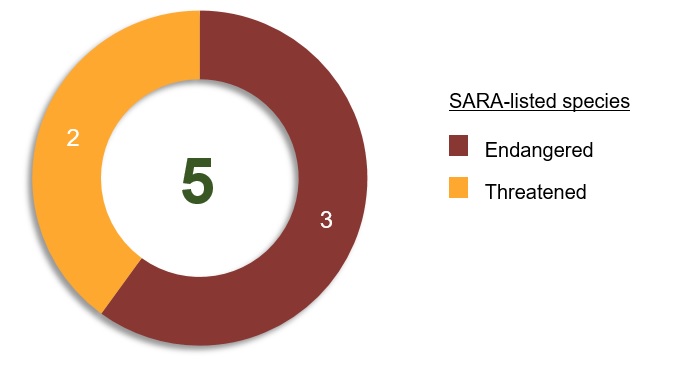
The action plan addressed five SARA-listed species. Measures and site-based population and distribution objectives identified within the action plan were focused on four species, for which management actions within Mount Revelstoke and Glacier National Parks could have a substantive impact on species survival or recovery: Little Brown Myotis, Northern Myotis, Whitebark Pine, and Woodland Caribou (Southern Mountain population).
Long description of diagram
This diagram shows a thick ring that is segmented into sections. Each section of the ring reflects a category of SARA classification, and is weighted in size based on the number of species in each category. The total number of species included in this report is reflected by a number in the middle of the ring. The diagram shows 5 total species, including 3 Endangered species, and 2 Threatened species.
Implementation of the action plan
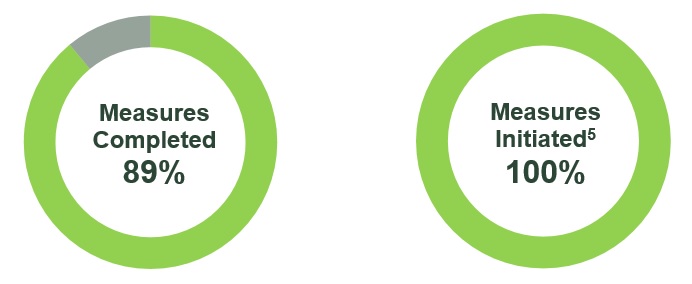
19 measures (recovery actions) were identified in the multi-species action plan. One measure was excluded from reporting, as it fell outside the scope of the plan. Implementation of the action plan is assessed by determining progress towards completing 18 measures, and is outlined in Section 2 of this report. During the five-year period, all 18 measures were initiatedFootnote 5 and 16 were completed.
Long description of diagram
This diagram shows two separate, thick rings. One ring shows that 100% of the measures in the action plan have been initiated and the other ring shows that 89% of the measures have been completed.
Ecological impacts
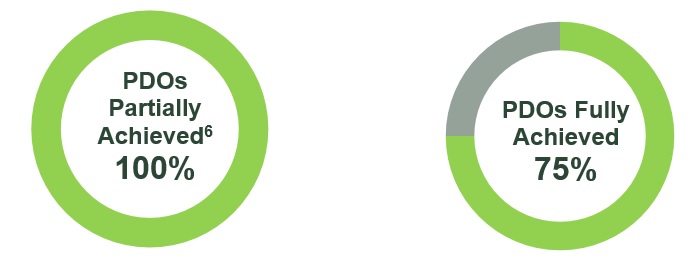
4 site-based, population and distribution objectives (PDOs) were developed in the action plan. Ecological impacts are assessed by measuring progress towards achieving each of the site-based population and distribution objectives and are outlined in Section 4. Progress was made on all objectivesFootnote 6 including three that were fully achieved.
Long description of diagram
This diagram shows two thick rings. One ring shows that 100% of the Population and Distribution Objectives were partially achieved (100%), while the other ring shows that 75% of the Population and Distribution Objectives were fully achieved.
Socio-economic Impacts
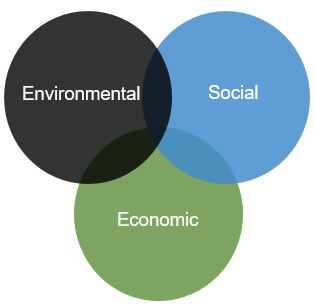
Direct costs of implementing this action plan were borne by Parks Canada. Indirect costs were mainly through visitor restrictions to certain areas of the parks to protect Woodland Caribou, Little Brown Myotis, and Northern Myotis. Benefits included positive impacts on park ecological integrity, greater awareness of species and enhanced opportunities for engagement.
Long description of diagram
This diagram shows three circles overlapping with one another in an upside-down triangle shape. Each circle has text in the middle. The top left circle says "Environmental", the top right circle says "Social", and the bottom circle says "Economic".
1. Context
This document reports on implementation of the Multi-species Action Plan for Mount Revelstoke National Park of Canada and Glacier National Park of CanadaFootnote 7 between 2017 and 2022, assesses progress towards meeting its population and distribution objectives, and evaluates its socio-economic impacts. It addresses five SARA-listed Endangered and Threatened species (for which an action plan is required)Footnote 8.
Site-based population and distribution objectives were developed for four species for which implementation measures within Mount Revelstoke and Glacier National Parks (MRG) could have a substantive impact on recovery: Little Brown Myotis, Northern Myotis, Whitebark Pine, and Woodland Caribou (Southern Mountain population).
2. Implementation of the action plan
Implementation of the Multi-species Action Plan for Mount Revelstoke National Park of Canada and Glacier National Park of Canada is assessed by measuring progress towards completing the recovery measures identified in the action plan (Table 1). Reporting on the implementation of recovery measures is inclusive of the 2017 to 2022 field seasons. Refer to the original action plan for a description of each measure, the desired outcomes, and the threats that each measure addresses.
In 2020, there were several restrictions put in place at Mount Revelstoke National Park (MRNP) and Glacier National Park (GNP) to combat the spread of COVID-19, including temporary restriction of park management activities. This caused some delays, but did not impact the ability of the park to complete the overall implementation of the action plan.
| Species and measure | Desired outcome | Progress towards outcome | Progress (% complete) |
|---|---|---|---|
1) Whitebark Pine: Identify suspected rust resistant individuals (Plus Trees) at high priority sites, conduct Plus Tree seed resistance testing for high probability trees, collect seed for genetic conservation and protect high value Plus Trees from mountain pine beetles. |
1. Where conditions permit, identify rust resistant trees or high value individuals and conserve genetic resources. 2. Where mountain pine beetle protection is required, protect high-value individual Whitebark Pine trees. |
Since 2014, 146 putatively resistant Plus Trees have been identified. Of these, 57 families have been submitted into a blister rust resistance testing program. Six families have been identified as having positive breeding values through this testing program and have been selected and planted at a new Whitebark Pine seed orchard located in British Columbia. | 100%* |
2) Whitebark Pine: Plant suspected rust resistant seedlings, and when available confirmed rust resistant seedlings, in priority restoration sites. Inoculate seedlings with mycorrhizal fungi to improve establishment. |
1. Plant a minimum of 3500 rust-resistant Whitebark Pine seedlings by 2019. Continue annual planting beyond 2019 as resources are available and based on priority areas for restoration need. 2. Where available, inoculate at least 50% of seedlings with mycorrhizal fungi prior to planting. |
Since 2014, Park staff have identified 146 potential Plus Trees for further resistance testing. Almost 90,000 seeds have been collected from potentially resistant Plus Trees to be grown into seedlings, and 12,389 seedlings have been successfully planted on the landscape. For the portion of the measure related to inoculating at least 50% of seedlings with mycorrhizal fungi prior to planting, it was not possible to inoculate seedlings due to unavailability of fungi. This was excluded from reporting as it was not applicable. |
100%* |
3) Whitebark Pine: Protect and, where feasible, increase the number and extent of existing stands and of blister rust resistant individuals through habitat management and restoration. |
1. Restore WBP habitat (e.g. guard burning, prescribed fire and mechanical thinning) to a degree that will allow the persistence or expansion of existing stands and the potential for generation of new stands. Target 20 hectares by 2019, and continue beyond as resources are available and based on priority areas for restoration need. 2. Mitigate threats in priority high value stands. |
Prescribed fires in GNP at 20-Mile (2020) and Flat Creek (2022) opened up a total of 297 ha of regeneration habitat (only area above 1590 m included in totals). DaylightingFootnote 9 was conducted at the sites of 31 Plus Trees to protect them from future fires and encourage seedling regeneration. Mechanical thinningFootnote 10 has been completed in 0.6 hectares of habitat to encourage Clark's Nutcracker caching as well as to reduce competition for Whitebark Pine individuals. | 100%* |
4) Woodland Caribou: Manage forests in caribou range to maintain and/or increase caribou habitat quality and availability. Reduce the impact of wildfire on caribou habitat through fire management planning. |
1. No large catastrophic fires in caribou range. 2. Maintain dynamic forest mosaic, protect old growth habitat, and prevent large scale disturbance that would alter predator-prey dynamics. |
There have been no large catastrophic fires in caribou range between 2017-2022. Three prescribed fires have been conducted in caribou core and matrix habitat between 2018 and 2022: Meadows in the Sky Parkway in MRNP (2019 and 2020), 20-Mile in GNP (2020), and Flat Creek in GNP (2022). These treatments act as a fireguard to protect large patches of caribou habitat from high intensity wildfires. All projects, events, initiatives and prescribed fire management plans consider impacts to caribou through the impact assessment process. The resource selection function (RSF) for caribou critical habitat was completed in 2019. |
100% |
5) Woodland Caribou: Reduce threat of disturbance in high quality caribou habitat through completion of fine scale mapping and by managing extent and timing of human activities. |
Maintain safe and secure high quality habitat. | Currently, 62 remote cameras have been installed throughout both parks to quantify and describe habitat quality via predator/prey dynamics and occupancy of caribou. Three years of intensive monitoring using remote cameras and snow tracking were conducted to assess the extent and timing of human activities on lower Mount Revelstoke in winter. The Mount Klotz closure on Mount Revelstoke was enacted to protect high quality caribou habitat. This closure was active for each of the five years, and monitored for compliance. Other temporary area closures (Farm Pass, Bostock, McGill) have been enacted to maintain safe and secure high quality caribou habitat on a reactive basis, informed by GPS collar data. |
100% |
6) Whitebark Pine, Woodland Caribou, Olive-sided Flycatcher: Implement prescribed fire for species at risk. |
Increase the number of prescribed fires targeted to benefit species at risk with the goal of implementing at least two every 5 years, and maintaining fire disturbance at 20% of the historical fire cycle. | Between 2017 and 2022, Parks Canada has implemented three prescribed fires which included specific objectives for providing benefits for Whitebark Pine, Woodland Caribou and Olive-sided Flycatcher. Within this five-year period, the fire disturbance in both Parks has been maintained above 20% of the historical fire cycle. The Meadows in the Sky Parkway prescribed fire on Mount Revelstoke burned 58.2 hectares between 2019 and 2020. The 20-Mile prescribed fire in Glacier National Park burned 68.1 hectares in 2020. The Flat Creek prescribed fire burned 354 hectares in Glacier National Park in 2022. | 100% |
7) Little Brown Myotis & Northern Myotis: Limit spread of white-nose syndrome by sharing protocols (such as the Canadian National White-Nose Syndrome Decontamination Protocol) for cave researchers, and maintaining access restrictions, to protect bats and their residences. |
1. Action plan developed for access to significant bat hibernacula and roosts before WNS arrives. 2. Limit human caused spread of WNS through increased awareness, enforcement of restricted access, and implementation of decontamination protocols and BMPs for researchers and cavers. 3. Establish best practices for Parks Canada staff and park stakeholders to address maintenance of infrastructure that contains roosts. |
Nakimu Caves were previously identified as a potential hibernaculum and have been closed to the public since 2016. These caves are accessible only to researchers possessing a restricted activity permit and by following the Canadian National White-nose Syndrome Decontamination Protocol, which was adopted in 2019. See measure #10 for the portion of this measure related to best management practices and inspection guidelines developed for bats in built assets and trees. |
100%* |
8) Little Brown Myotis & Northern Myotis: Compile existing data and knowledge using NABat/BCBat and GIS to identify and prioritize sites that have a high potential to be hibernacula or maternity colonies. As resources are available and based on priority, sample sites to determine their significance. |
Status has been determined for known hibernacula and maternity colony caves and roosts during first 5 year reporting period. | No hibernacula or maternity roosts have been found in MRNP and no new hibernacula or maternity roosts have been identified in GNP. Annual acoustic monitoring as part of the North American Bat Monitoring Program has now occurred for five years, which has facilitated assessing trends in bat species detection. However, this monitoring has not facilitated the identification of new roosts or hibernacula. In 2022, MRG supported a collaborative research project with the province of British Columbia which aimed to identify maternity roosts in trees of Northern Myotis through capture and telemetry of pregnant or lactating females. In this first year of the project, no pregnant or lactating female Northern Myotis were captured. | 100%* |
9) Whitebark Pine: Complete predictive habitat model and map of Whitebark Pine distribution for the park. Where stand assessments are completed, they include aspects of stand health (i.e., rust presence/not detected and stand density). |
1. Predictive map of Whitebark Pine distribution for the park. 2. Assessed high-value stands in high risk areas. 3. Data inform targeted and efficient management and recovery. |
Parks Canada has developed a guide for determining fine-scale critical habitat for Whitebark Pine. Using this guide, a map of potential critical habitat in the park has been prepared. Twenty stand assessments have been completed in MRG which incorporate stand health. Additionally, Whitebark Pine long term health monitoring transects were assessed in 2014 and 2019, and sampling will be repeated every 5 years. A Vegetation Resource Inventory was also completed in 2019, which will be ground-truthed in future years. |
100%* |
10) Little Brown Myotis & Northern Myotis: Adopt best practices for the maintenance or decommissioning of MRG infrastructure that may contain Little Brown and/or Northern Myotis roosts. |
Important roosts identified for infrastructure requiring maintenance and impacts are mitigated. | Best management practices and the Mount Revelstoke and Glacier National Parks Guidelines for Inspection of Trees and Built Assets for Bats were adopted in 2019. | 100%* |
| 11) Little Brown Myotis & Northern Myotis: Engage with the public to obtain bat sightings to increase understanding and support for important hibernacula or roosts. |
Increase basic understanding of the bat distribution. Minimum counts for reported hibernacula and important roosts. |
Species-specific communications aimed at raising awareness about endangered bats and facilitating reporting of observations have been delivered annually since 2017. Initiatives that support increased understanding among the public have included: a public presentation for the Columbia Mountains Institute of Applied Ecology about our monitoring at the Nakimu Cave system, installation of interpretive signs at the new Snowforest campground in Mount Revelstoke, and social media posts to aid in identification of bats and encourage reporting of bat sightings. | 100%* |
12) Woodland Caribou: Work with partners to determine next steps for local population unit (LPU) augmentation in the mountain national parks. Prioritize actions based on assessment of conditions including predator-prey dynamics, predation risk, and translocation recovery priority of other caribou populations (e.g. Alberta). |
Increasing population trend for one subpopulation in the short-term and other subpopulations to follow. Over the long term, the LPU is self-sustaining. Continue partnership with RCRW to double pen-born calf survival to 10 months of age over wild-born calves in the Columbia North caribou herd over a five-year period. Recovery and range plans completed for Columbia South herd and Duncan sub-populations. |
Since 2017, the Columbia North herd (one subpopulation of the LPU) has continued to increase in size. As of 2021, the Province of BC is reporting that this positive trend is attributed to three recovery actions (prey and predator management and maternal penningFootnote 11). MRG is working with partners to discuss population augmentation options for the Revelstoke-Shuswap LPU and the Jasper/Banff LPU.Footnote 12 The partner-led Revelstoke Caribou Rearing in the Wild (RCRW) pilot project conducted its last operational year in 2018. The initiative was a success in that it determined that pen-born calf survival could be doubled through maternity penning. Parks Canada has been engaged in the preparation of province-led draft herd plans for all herds in the Revelstoke-Shuswap LPU (Columbia South, Columbia North and Frisby-Boulder-Queest) and for the Central Selkirks LPU (Duncan and Nakusp herds). |
92%* |
13) Woodland Caribou: Continue communications activities delivered as part of on going local and regional efforts to communicate and raise general awareness about Woodland Caribou. |
Increased awareness about this species among Canadians and maintain public support for the implementation of caribou conservation actions. | Interpretive media, outreach products, and social media have been used to communicate species-specific stories in and outside of the park. At least one communication product on Woodland Caribou has been featured annually since 2017. Communications are in place to protect critical habitat (e.g. signage for Woodland Caribou closures), increase awareness (including interpretive signage and outreach programming that took place in key urban centres), and support the Revelstoke Caribou Rearing in the Wild program. Twenty posts (2017-2022) on Woodland Caribou, including the annual Mount Klotz closure and temporary area closures in GNP, were shared on social media channels. |
100%* |
14) Whitebark Pine: Continue communication activities aimed at increasing awareness of, and reducing human-caused impacts on, Whitebark Pine as outlined in the CoRe Whitebark Pine Conservation Project. |
Increased awareness about this species among priority audiences; Reduction of accidental harm/removal of Whitebark Pine trees. | The Mountain Parks have collaborated on and delivered a 5-needle pine Communications Plan. Park staff have actively worked with stakeholders on a Whitebark Pine friendly ski hills initiative, supported educational exhibits, launched a tree guardian program with local schools, and participated in two Whitebark Pine Open Standards workshops with key partners. Within MRG, interpretive media featuring Whitebark Pine have been created including an interpretive program, trail-head signage, and a geocaching program. In 2020, an interactive Whitebark Pine cone sculpture was installed in the new Snowforest campground. In 2021, a 5-needle pine mitigation document for industry was created and a bilingual film was produced by the Mountain Parks. In 2022, a virtual Whitebark Pine educational episode was delivered to classrooms across Canada. | 100%* |
| 15) Multi-species (including caribou): Identify potential highway crossing mitigations to reduce the threat of wildlife-vehicle collisions. |
Highway crossing mitigations appropriate for caribou and other ungulates as well as carnivores are designed and installed by 2030 potentially including: • crossing structures at priority locations in collaboration with partners. • highway infrastructure design that integrates the needs of wide-ranging high-altitude wildlife species. |
The scope of this measure is beyond the 5-year window of the action plan, so it was not included in the total. To date (2022), 18 potential under-over pass locations have been identified in both parks. These locations have been selected based on wildlife movement analysis, wildlife mortality hotspots, constructability (based on terrain features), existing infrastructure and conceptual designs for highway improvements. Mitigations constructed to date include: a wildlife pathway under a highway bridge, snowshed crossing structures, small animal underpasses and shelf-ready projects with advanced designs completed. |
N/A*Footnote 13 |
16) Multi-species: Increase general awareness about species at risk that are found in the park, through interpretive programming, targeted communications, stakeholder engagement and outreach. |
Increased support and action for SAR conservation and associated management activities. Priority audiences, including park visitors, youth, urban and new Canadians, learn about species at risk found in the parks. Create a Species at Risk Communication Strategy. Support an integrated approach towards increased compliance to prevent habitat degradation and human-caused mortality. |
Interpretive media, outreach products, and social media have been used to communicate species at risk stories in the park. At least one story on Woodland Caribou, Whitebark Pine, Olive-sided Flycatcher, Northern Myotis and Little Brown Myotis have been featured annually since 2017. A Species at Risk Communication Strategy has been developed that includes species at risk as a priority topic for future outreach and interpretation communications. |
100%* |
17) Multi-species: Provide timely and effective species-specific communications to target audiences to disseminate knowledge, enhance understanding, promote prevention and ensure compliance with SARA requirements. |
Visitor activities are successfully managed to prevent habitat destruction or harm to individuals of a species. | Communications are in place to disseminate knowledge, enhance understanding, promote prevention and ensure compliance with SARA requirements to protect critical habitat. At least one new communication product has been developed for Woodland Caribou, Whitebark Pine, Olive-sided Flycatcher, Northern Myotis and Little Brown Myotis annually since 2017. | 100% |
|
18) Multi-species: Indigenous knowledge is incorporated to fill species knowledge gaps. Explore the interests of various Indigenous communities in SAR education and recovery. Collaborate with interested communities on outreach, education and visitor experience actions in mutually agreed upon ways. |
Indigenous Knowledge incorporated to fill species knowledge gaps. Increased Indigenous community involvement in the delivery of SAR outreach, education and visitor experience actions. |
MRG is in the early stages of building relationships with Indigenous partners. Progress completed (25%) reflects early stages of relationship building and ongoing dialogue with Indigenous partners. |
25%* |
19) Multi-species: Parks Canada Staff and Law Enforcement continue to collaborate together to promote awareness, compliance, prevent disturbance and enforce infractions to SAR and their habitats. |
Parks Canada Staff will continue to actively work to Prevent disturbance, destruction or removal of species at risk and their habitats. | Law Enforcement have worked with Park staff to implement SAR regulatory compliance annually (2017 – 2022). Law Enforcement implemented compliance by installing closure signage, conducting patrols, investigating reports of non-compliance, and monitoring boundaries for incursions. Mount Klotz closure has been enacted to protect Woodland Caribou habitat since 2007. Other temporary area closures (Farm Pass, Bostock, McGill) have been enacted to secure caribou habitat on a reactive basis, informed by GPS collar data. Park Wardens investigated two incidents related to caribou closure violations during the winter of 2021/2022. Nakimu Cave closure has been active since 2016 to protect bat roosting habitat. Law Enforcement reviews all Restricted Activity Permits to ensure compliance with federal legislation. |
100%* |
3. Action plan highlights
Whitebark Pine Restoration
Whitebark Pine is the only tree in western Canada that is currently listed as Endangered under the Species at Risk Act (SARA). Mount Revelstoke and Glacier National Parks are taking action towards restoration for this keystone species through multiple approaches.
Whitebark Pine stands with a high blister rust infection rate are surveyed for healthy Plus Trees that likely have genetic resistance to the fungus. Since 2014, Park staff have identified 146 putativelyFootnote 14 resistant Plus Trees for further resistance testing. Almost 90,000 seeds have been collected from the most highly resistant Plus Trees to be grown into seedlings, and 12,389 seedlings have been successfully planted on the landscape.
Prescribed fire has been applied to enhance habitat with the goal of maintaining fire disturbance at 20% of the historical fire cycle. Park staff successfully used two prescribed fires to maintain 297 hectares of Whitebark Pine regeneration habitat (area above 1590 meters) between 2017-2022.
Park staff have completed daylighting to protect 31 high value Plus trees from high intensity fire and mechanically thinned over 0.6 hectares of Whitebark Pine forests of competing vegetation to create open areas where Clark's Nutcrackers preferentially cache Whitebark Pine seeds. These cached seeds are the primary means of Whitebark Pine seed dispersal across the landscape.
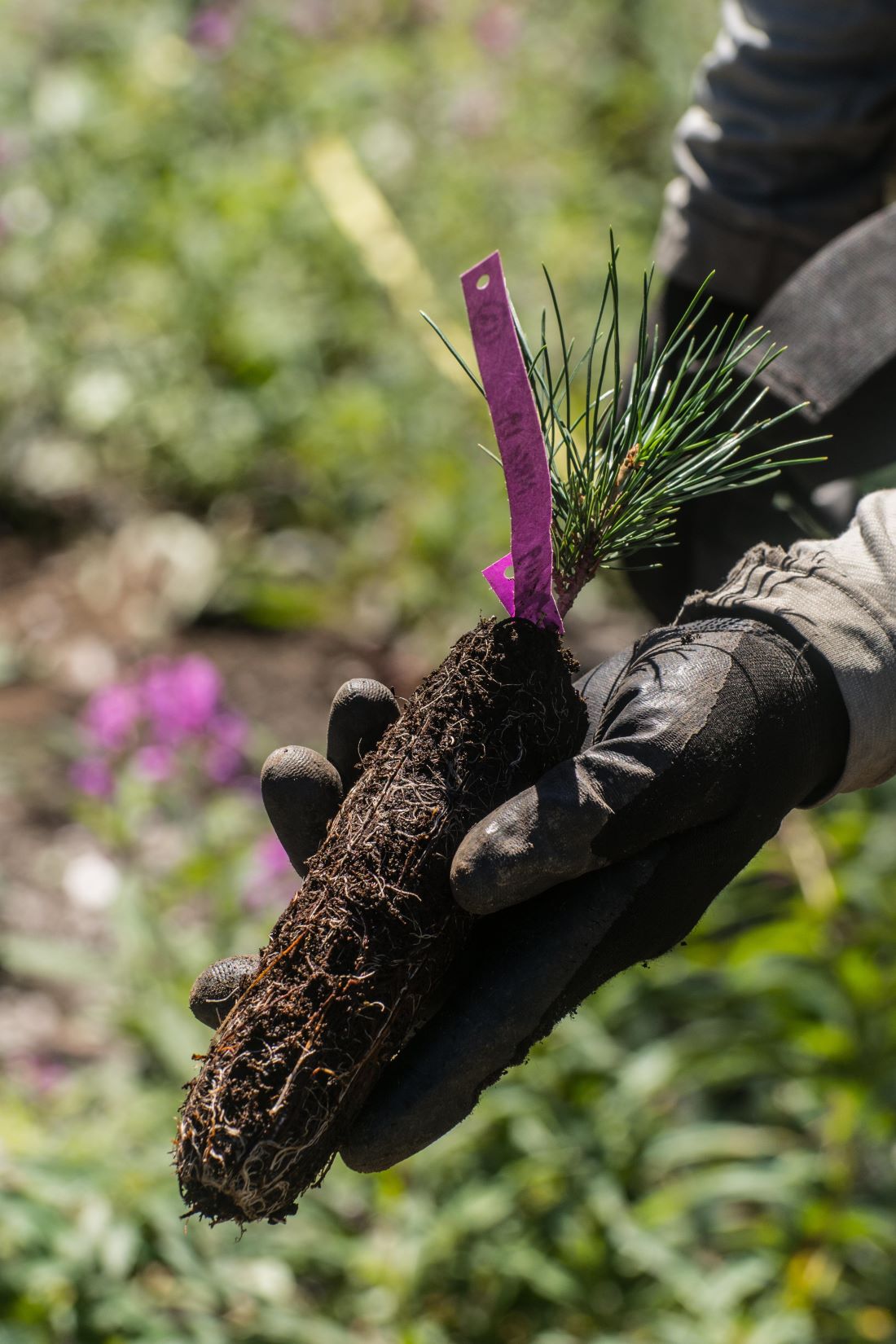
Long description of image
This is a photograph of a Whitebark Pine seedling about to be planted in the ground. The seedling is small with a long plug. There is a tag looped around the stem that denotes the parentage of the tree. A staff member is holding the plug with a gloved hand.
Managing Recreation in Woodland Caribou Critical Habitat
Mount Revelstoke and Glacier National Parks provide high elevation, mature and old-growth forests abundant in arboreal lichens, the preferred food source for the southern mountain population of Woodland Caribou. These high elevation slopes also make for world-class ski-touring terrain. Recreational activities like ski-touring can harm caribou by displacing them from important winter habitat, as caribou are wary of human presence.
A combination of annual and temporary area closures, along with population monitoring has been used in both parks to prevent and minimize disturbance to caribou in winter habitat. Since 2007, an annual closure to protect caribou habitat on Mount Klotz in Mount Revelstoke National Park has been implemented. Since winter 2020/2021, three separate temporary closures for caribou in the vicinity of Bostock Pass in Glacier National Park (GNP) – a popular ski-touring area – have been applied. In spring 2020, two female caribou from the local Columbia South herd that occupy habitat in GNP, were fitted with GPS (Global Positioning System) collars to track their movements through satellite telemetry. A combination of real-time location data from the collars, ground and aerial surveys, drone imagery, and remote camera data, are used to understand how caribou are using this habitat and manage the closure areas. Public compliance with winter seasonal closures has been nearly 100% in recent years, allowing caribou unobstructed access to critical winter habitat.
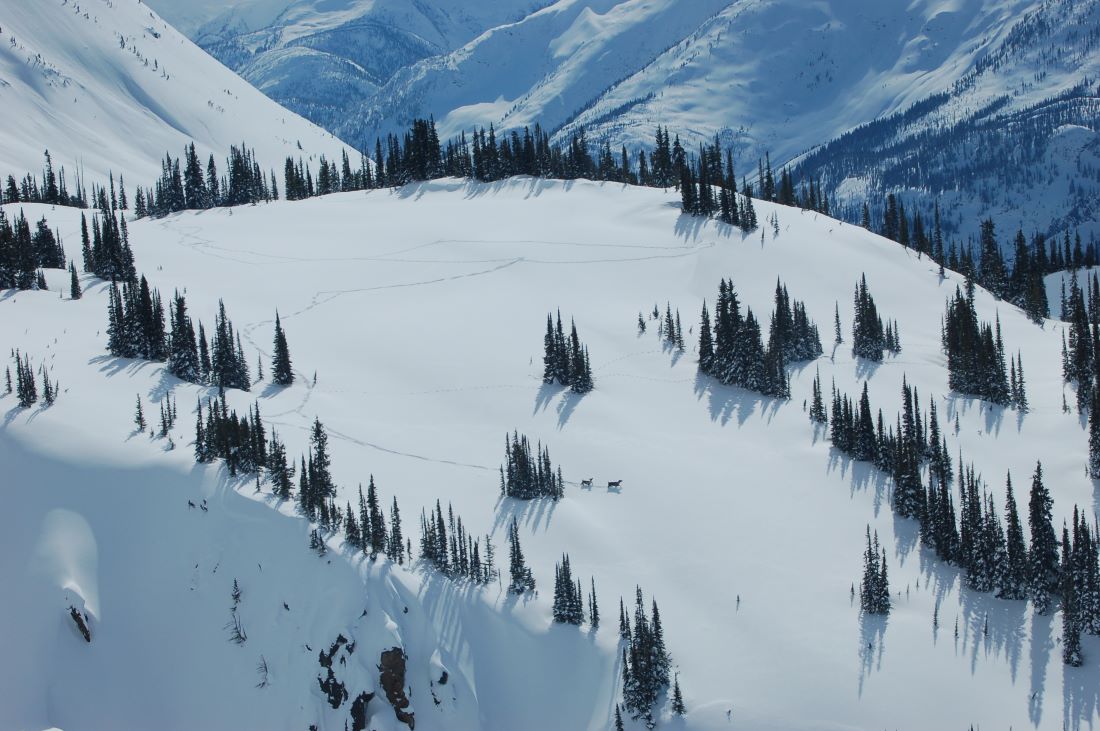
Long description of image
This is a photo of two Woodland Caribou foraging in winter. They are walking through deep snow, and you can see their tracks behind them. They are pictured in a high elevation, mature and old-growth forest abundant in arboreal lichens, the preferred food source for the southern mountain population of Woodland Caribou.
4. Ecological impacts
Ecological impacts of the action plan are assessed by measuring progress towards meeting the site-based population and distribution objectives described in the action plan (Table 2). See the original action plan for national Population and Distribution Objectives (where available) and General Information and Broad Park Approach for each species. A more detailed description of progress made towards the site-based population and distribution objectives for Whitebark Pine is outline in Appendix A.
| Species | Site-based population & distribution objectives | Population monitoring | Progress towards site-based population and distribution objectives | Progress (% achieved) |
|---|---|---|---|---|
| Little Brown Myotis | Maintain occupancy and extent of distribution. Where population sizes are currently known at confirmed hibernacula and maternity roosts, maintain populations at current levels. | 1. Use the North American Bat Monitoring Protocol (NABat/BCBat) and opportunistic observations to identify significant bat locations in natural areas and human structures. Monitor these sites to detect changes. 2. Monitor for bat use and hibernation activity in priority caves and mines using roost loggers. |
Little Brown Myotis were detected in MRNP in four out of five years and in GNP in five out of five years. Surveys were conducted at danger trees slated for removal during breeding season to detect roosting. No maternity roosts have been identified thus far. | 100% |
| Northern Myotis | Maintain Northern Myotis populations at current levels, including at hibernacula and other confirmed sites within MRG. | 1. Use the North American Bat Monitoring Protocol (NABat/BCBat) and opportunistic observations to identify significant bat locations in natural areas and human structures. Monitor these sites to detect changes. 2. Monitor for bat use and hibernation activity in priority caves and mines using roost loggers. |
Northern Myotis were detected in MRNP in three out of five years and in GNP in three out of five years during acoustic monitoring at both stationary monitoring sites and driving transects. Surveys were conducted at danger trees slated for removal during breeding season to detect roosting. No maternity roosts have been identified thus far. | 100% |
| Whitebark Pine | To establish a self-sustaining, rust-resistant population of Whitebark Pine throughout the species' range in MRG that demonstrates natural seed dispersal, connectivity, genetic diversity and adaptability to changing climate. | 1. Disease infection, stand density and mortality rate via stand health transects. 2. Hectares of habitat created or restored. 3. Number of potentially resistant trees identified and protected and number of these with stored seeds. 4. If fire is applied, the amount of regeneration 5-years post-fire. |
Whitebark Pine condition continues to decline. Stand health transects conducted from 2003-2019 showed blister rust infections staying relatively stable. Restoration activities have been applied across the park such as habitat creation/restoration, and the identification, protection and seed storage from potentially rust-resistant trees. Overall progress completed is calculated as an average of the four monitoring components (see Appendix A for more detailed information). |
40% |
| Woodland Caribou | Maintain caribou occupancy within parks and regional local population units (LPUs). Maintain critical habitat in MRG. Where caribou have been extirpated, examine opportunities for restoration. | Caribou population monitoring (census) in conjunction with the province. | Continued occupancy of caribou has been confirmed in all three of the herds comprising the Revelstoke-Shuswap local population unit (LPU) up to and including 2022 as reported by the Province of BC census surveys. For the portions related to population trends and maintaining critical habitat, refer to recovery measures 4, 6 and 12. |
100% |
5. Socio-economic impacts
The Species at Risk Act requires the responsible federal minister to report on the socio-economic costs of the multi-species action plan (MSAP) and the benefits derived from its implementation. The MSAP only applies to protected lands and waters under the authority of the Parks Canada Agency, which are often subject to fewer threats (e.g., industrial activities) compared to other areas as the lands are managed to preserve ecological and commemorative integrity. This section does not include socio-economic impacts of existing permitted activities that may be occurring in Parks Canada places as those have been addressed through other processes (e.g., impact assessments). This socio-economic assessment is narrow in scope, as it is focused on the measures implemented within the action plan, and primarily focuses on Indigenous partners, leaseholders, licensees, residents and visitors. The overall socio-economic impacts of the MSAP for Mount Revelstoke National Park of Canada and Glacier National Park of Canada, described as costs and benefits, are outlined below.
Costs
Most costs to implement this action plan were borne by Parks Canada out of existing salaries and goods and services dollars. This includes incremental salary costs, materials, equipment, and contracting of professional services for measures outlined in the action plan. No major socio-economic costs to partners, stakeholders or Indigenous groups were reported as a result of this action plan.
Additional resources or partnerships were provided by the Revelstoke Caribou Rearing in the Wild Society, Province of British Columbia, and Environment and Climate Change Canada who provided support to implement caribou census, population augmentation and herd planning. Collaborations with the Province of British Columbia, the North America Bat Monitoring Program, and the Wildlife Conservation Society Canada have supported bat occupancy and species distribution monitoring. Partnership with the Whitebark Pine Ecosystem Foundation of Canada and the Province of British Columbia has supported white pine blister rust resistance testing, seed orchards, as well as seed storage. In addition, Vancouver Science World and the Calgary Zoo provided support to bring MRG's species at risk stories to Canadians where they live.
The proposed measures were integrated into the operational management of MRG and there were no new costs. These costs to the Parks Canada Agency were covered by prioritization of existing funds and salary dollars and did not result in additional costs to society.
The action plan applies only to lands and waters in MRG, and did not bring any restrictions to land use outside the sites. As such, this action plan placed no additional socio-economic costs on the public. However, minor restrictions were placed on visitor activities on park lands and waters to protect and recover species at risk. The Mount Klotz area closure has been enacted in Mount Revelstoke National Park to protect Woodland Caribou winter habitat since 2007. This closure restricts winter recreational access into caribou habitat from December 15 to April 15 annually. Other temporary area closures in Glacier National Park (e.g., Farm Pass, Bostock, McGill) have been enacted to protect caribou when needed based on caribou presence in the area. Access to Caribou Cabin and overnight winter camping on Mount Revelstoke National Park has been restricted to reduce potential disturbance to caribou winter habitat from 2019 to 2022. Nakimu cave closure in Glacier National Park has been active since 2016 to protect bat roosting habitat.
Benefits
Measures presented in this action plan for MRG contributed to meeting recovery / population and distribution objectives for Threatened and Endangered species. These measures had an overall positive impact on ecological integrity and enhanced opportunities for appreciation of the sites and the species by visitors and the general public. This action plan included measures that likely resulted in benefits to Canadians, such as positive impacts on biodiversity and the value individuals place on preserving biodiversity.
The measures sought a balanced approach to reduce or eliminate threats to at-risk populations and habitats, and included protection of individuals and their habitat (e.g., restrictions to human activities within areas occupied by the species, combined with ongoing research and monitoring), potential species re-establishment, and increasing public awareness and stewardship (e.g., interpretive signage, visitor programs, and highlights in communication media).
Working with partners and stakeholders, MRG has implemented restoration actions towards achieving self-sustaining Whitebark Pine populations across their range. Almost 90,000 seeds have been collected from the most highly white pine blister rust resistant Plus Trees to be grown into seedlings, and 12,389 seedlings have been successfully planted on the landscape. By applying prescribed fire to 297 hectares of Whitebark Pine regeneration habitat (area above 1590 m elevation), daylighting 31 Plus trees and mechanically thinning 0.6 hectares of Whitebark Pine forest, forest habitat has been enhanced for Whitebark Pine. These treatments optimize habitat by reducing the risk of high intensity fire, providing higher resilience to disease and pest pathogens, and reducing competition from encroaching vegetation.
MRG undertook coordinated planning among provincial and federal jurisdictions that jointly manage local Woodland Caribou (Southern Mountain population) herds for their recovery. The partner-led Revelstoke Caribou Rearing in the Wild pilot project brought together partners and stakeholders of all kinds to work towards a common goal, and created a model and a set of protocols for other groups to use in the future. MRG is actively engaged with the Province of British Columbia on the provincially-led herd planning process for the Revelstoke-Shuswap local population unit herds and the Central Selkirks. MRG is working with the Province of British Columbia and Jasper National Park on discussions regarding recovery options for the Revelstoke-Shuswap local population unit.
Potential economic benefits of the recovery of the species at risk found in these sites cannot be easily quantified, as many of the values derived from wildlife are non-market commodities that are difficult to appraise in financial terms. Wildlife, in all its forms, has value in and of itself, and is valued by Canadians for aesthetic, cultural, spiritual, recreational, educational, historical, economic, medical, ecological and scientific reasons. The conservation of wildlife at risk is an important component of the Government of Canada's commitment to conserving biological diversity, and is important to Canada's current and future economic and natural wealth.
Implementing this action plan had positive benefits for park visitors, local residents, and the Canadian public. Innovative urban outreach tools and activities like the mountain national parks' Whitebark Pine, caribou and fire travelling exhibit, MRG's species at risk outreach kit, and collaboration with the Vancouver Science World and the Calgary Zoo, bring MRG's stories to Canadians where they live. For visitors to the parks, interactive programs such as the campfire program on Whitebark Pine at Illecillewaet Campground and the Whitebark Pine seedling planting program for schools, offer hands-on learning about species at risk and Parks Canada's recovery actions. Working with the Revelstoke Caribou Rearing in the Wild Society, MRG has enlisted community and student volunteers to help collect lichen for pregnant caribou temporarily held during maternal penning.
The plan supported the goals under the Species at Risk Act "the traditional knowledge of the aboriginal peoples of Canada should be considered in the assessment of which species may be at risk and in developing and implementing recovery measures" by relationship building with Indigenous partners and providing opportunities for Indigenous involvement and integration of Indigenous Traditional Knowledge. MRG is in the early stages of establishing relationships with Indigenous partners and dialogue is ongoing.
Summary
The measures proposed in the action plan had limited socio-economic impact and placed no restrictions on land outside the boundary of the national parks. Direct costs of implementing this action plan were borne by Parks Canada. Indirect costs were mainly through visitor restrictions to certain areas of both Mount Revelstoke and Glacier National Parks to protect Woodland Caribou, and restrictions to Glacier National Park to protect Little Brown Myotis and Northern Myotis habitat, while benefits included positive impacts on park ecological integrity, greater awareness of species and enhanced opportunities for engagement of visitors, local communities and Indigenous partners.
Appendix A. Technical Compendium – Population and Distribution Objectives
Whitebark Pine
The following table supports the summary population and distribution progress statements in Table 2.
| Site-based population & distribution objectives | Population monitoring | Progress towards site-based population and distribution objectives | Progress (% achieved) |
|---|---|---|---|
| To establish a self-sustaining, rust-resistant population of Whitebark Pine throughout the species' range in MRG that demonstrates natural seed dispersal, connectivity, genetic diversity and adaptability to changing climate. | 1. Disease infection, stand density and mortality rate via stand health transects. |
1. Whitebark Pine condition continues to decline (progress estimate = 0%). Blister rust infection rates for live trees remains relatively stable from 50.7% in 2003 to 46.9% in 2019; this rate remains moderate compared with most areas of Whitebark Pine habitat. Stand density of cone producing trees is 5.3 m2 per hectare which is good (<2 m2 is poor). This means that natural regeneration is still occurring. |
0% |
| 2. Hectares of habitat created or restored. | 2. Park staff planted over 12,300 seedlings since 2014 and collected more than 90,000 seeds. Based on recent restoration plans for similar areas, it is likely that 250,000 seedlings may be required to meet long-term objectives (preliminary progress estimate = 5%). | 5% | |
| 3. Number of potentially resistant trees identified and protected and number of these with stored seeds. | 3a. Park staff have identified 146 potentially resistant trees and over 57 of these parent trees are in blister rust resistance testing programs. Early results found that six trees from MRG have positive breeding values and have been planting out in a new WBP seed orchard in British Columbia. Progress is measured base on the Open Standards draftFootnote 16. The goal is to have ten parent trees with positive breeding values in our region. MRG currently has six parent trees in the seed orchard. Progress estimate is 60%. | 60% | |
| 3b. Low to moderate levels of Mountain Pine beetle have been documented in the Bald Hills of Glacier National Park. Plus Trees in this area are protected annually with pheromones with no mortality from beetles recorded. Since 2014, five of these Plus Trees have died from fire. The progress estimate for the number of potentially resistant trees protected is 97%. | 97% | ||
| 4. If fire is applied, the amount of regeneration 5-years post-fire. | 4. In 2020, a prescribed fire at 20-mile opened up 68 hectares of Whitebark Pine regeneration habitat while a 2022 prescribed fire at Flat Creek opened up 229 hectares of regeneration habitat. Park staff have been planting in previously burned wildfire sites since 2014. Regeneration has not been assessed as sufficient time has not yet elapsed post-fire. Mechanical thinning has been completed in 0.6 hectares, which is a small area, relative to the amount of Whitebark Pine habitat. | Not reportable | |
| Overall progress is calculated as an average of the four monitoring components. | Overall 40% |
A monitoring program began in 2003 to measure the condition of Whitebark and Limber Pine in the Canadian Rocky and Columbia Mountains. Permanent plots from the Canada-United States border to the Willmore Wilderness in the north have been re-measured every 5-years. The data on blister rust infection levels, tree mortality and natural regeneration help direct restoration action across national parks, provincial parks, and Alberta and British Columbia provincial lands. While these data are important, Whitebark Pine is very slow-growing, and it will take many decades for this type of population monitoring to respond to restoration action such as seed collecting, seedling planting, or prescribed fire (Figures 1 and 2).
Since the action plan was written, restoration experts have identified goals to measure progress to meet population and distribution objectives for Whitebark Pine recoveryFootnote 17. The approach, which can be refined for a region, recommends a network of "component populations" that consist of >5,000 mature parent trees located within 12 km of another component population (within 30% of the species' regional range). Given existing seedling survival estimates (~50%), roughly 10,000 putativelyFootnote 18 resistant seedlings should be planted in each component population. This approach synthesizes the best available datasets and science into a flexible, data-informed decision-making process that can be applied consistently across large geographic areas, and importantly, we can measure progress towards recovery. Moving forward, monitoring the condition of "component populations" may be identified as the approach to measure progress toward meeting population and distribution objectives.

Text description
This is a map showing the locations of two habitat restoration actions completed in Mount Revelstoke and Glacier National Parks; seedling planting, and mechanical thinning (where competing vegetation is removed surrounding Whitebark Pine trees).

Text description
This is a photograph of a Whitebark Pine seedling that is ready to be planted. There are nine seedlings in the photo wrapped together with plastic. The background is of rocky, jagged mountain peaks and a smokey sky.
- Date modified :