
Evaluation of the National Cost-Sharing Program for Heritage Places

Publication information
Ce document est disponible en français.
Office of Internal Audit and Evaluation
Parks Canada
30 Victoria Street
Gatineau, QC J8X 0B3
©His Majesty the King in Right of Canada, represented by the Chief Executive Officer, Parks Canada, 2024
CAT. NA
ISBN: NA
Table of contents
Title: Evaluation of the National Cost-Sharing Program for Heritage Places
Organization: Parks Canada Agency
Date: April, 2024
List of tables and figures
List of Tables
| Number | Titles |
|---|---|
| Table 1 | Acronyms and Abbreviations |
| Table 2 | Funded Projects by Group Type 2017 to 2024 |
| Table 3 | CSP Application Intake, Requested and Available Funds, 2017-18 to 2022-23 |
| Table 4 | Compared Contribution Percentages and Project Deadlines (2023 Guidelines) |
| Table 5 | Overview of CSP Data Types |
| Table 6 | Funding Rates by Organization Type (2017-2023) |
| Table 7 | Funding Rates by Location (2017-2023) |
| Table 8 | Location of Applicants Compared to Designation Data |
| Table 9 | Reported Conservation Planning |
| Table 10 | Effort Required was Reasonable by Access to Expertise |
| Table 11 | Applications Submitted, Funded and Success Rate; Access to Expertise |
| Table 12 | Applications Submitted, Funded and Success Rate; Staffing Composition |
| Table 13 | Success Rate by Staffing Composition |
| Table 14 | Organization Types by Access to Expertise |
| Table 15 | Overview of Applications by Indigenous Governments and Organizations |
| Table 16 | List of Reviewed Programs and Contributions Limits per Program |
| Table 17 | UNDRIP and Indigenous Stewardship Framework Crosswalk |
List of Figures
| Number | Titles |
|---|---|
| Figure 1 | Cost-Sharing Program Key Steps and Milestones |
| Figure 2 | Cost-Sharing Program Logic Model |
| Figure 3 | Cost-Sharing Program Data Map |
| Figure 4 | Primary Descriptive Categories for Applicants |
| Figure 5 | Indigenous Stewardship Framework |
| Figure 6 | National Cost-Sharing Program Application Requirements |
| Figure 7 | Staffing Resources |
| Figure 8 | Access to Technical Experts |
| Figure 9 | Regular Operation Funding |
| Figure 10 | Conservation Project Funding |
| Figure 11 | Meeting the 50% Requirement |
| Figure 12 | Staff Involved in Applications |
| Figure 13 | Reported Application Prep Time |
| Figure 14 | Allotted Project Time |
| Figure 15 | Perceptions of the Application Process |
Acronyms and abbreviations
| Acronyms | Names in Full |
|---|---|
| CSP | National Cost-Sharing Program for Heritage Places |
| GBA Plus | Gender-Based Analysis Plus |
| GCGCP | General Class Grants and Contributions Program |
| UNDRIP | United Nations Declaration on the Rights of Indigenous People |
| VP IACH | Vice-President, Indigenous Affairs and Cultural Heritage |
Program profile
The National Cost-Sharing Program for Heritage Places awards funding to federally recognized heritage places in support of work required to ensure their physical health and maintain or communicate their heritage value. Funding is awarded through an application process that typically occurs in a yearly cycle. Federal government organizations, for-profit organizations, private owners, and business entities are excluded from the program. Eligible recipients must be the owner or long-term lessee of a federally recognized heritage place as well as one of the following:
- a not-for-profit organization.
- a regional or municipal government.
- a provincial or territorial government, agency, or institution.
- a not-for-profit Indigenous organization with a formalized stewardship responsibility directly related to all or part of a heritage place, or.
- a not-for-profit Indigenous organization acting on behalf of an eligible Indigenous organization.
Eligibility also depends on organizations being able to demonstrate that they have a minimum of 50% of the required funds in place through their own resources, private support, or other non-federal government support. Funding levels for the CSP have varied over the past five years, however, as of 2022, the maximum amount that can be distributed is $2 million dollars per fiscal year; an increase from the previous baseline of $1 million.
Applications and selection
An overview of the Cost-Sharing Program's key steps and milestones is provided in Figure 2 below. Submissions to any of the three components of the Cost-Sharing Program, preparatory assistance, conservation, or presentation, include a completed application form containing descriptions of project plans, and sites' character-defining elements; documents confirming eligibility, such as proof of ownership or not-for-profit status; and detailed supporting information such as budgets, cost estimates, financial statements, photographs, and architectural drawings.
Eligible applications are scored by a team of Cost-Sharing Program staff as well as members of Parks Canada's Built Heritage group. After reviewing submissions individually, the team meets to discuss each submission and finalize scores. A second assessment is provided by an Executive Review Committee, made up of Parks Canada executive staff, who review the initial results, discuss, and endorse funding recommendations.
Application scores are based on five criteria:
- the level of threat to sites' heritage value(s)
- the suitability of the proposed mitigations
- adherence to the Standards and Guidelines for theConservation of Historic Places in Canada
- demonstrated financial need, and financial risk levels (e.g., financial stability and management capacity), and
- the ability to complete the proposed project by the end of the calendar year.
Recent program guidelines have also indicated that priority may be given to projects that better represent the diversity and complexity of Canadian history, address the effects of climate change, and/or advance accessibility or inclusion at heritage places. Funding may also be granted conditional upon the organizations meeting additional requirements.
As shown in Table 2, 152 projects were funded by the Cost-Sharing Program between 2017 and 2023. The majority were submitted by not-for-profit and religious groups, accounting for 53% of total funded projects. Indigenous governments and organizations have generally made up a small percentage of Cost-Sharing Program recipients; however, the proportion has risen in the last few years, due to a new pilot project (see Figure 2 Program Logic Model)
| Organization Types | Funded Projects | % of total projects |
|---|---|---|
| Not-for-profit organizations | 47 | 31% |
| Religious groups | 33 | 22% |
| Municipal governments | 24 | 16% |
| Historical societies | 22 | 14% |
| Indigenous Gov. / Not-for-profits | 10 | 7% |
| Provincial / Territorial governments | 8 | 5% |
| Educational institutions | 5 | 3% |
| Other governments | 3 | 2% |
| Total | 152 |
Pilot projects
Alongside the three current funding categories, the Cost-Sharing Program recently piloted a new stream for national heritage places administered by Indigenous organizations and governments.
Initiated under the financial authorities of Parks Canada's General Class Contributions and Grants Program to provide greater flexibility in eligible expenses and the transfer of funds, seven projects have been approved since 2022.
Policy guidance
The most recent amendments to the Cost-Sharing Program's Terms and Conditions were approved in September 2022. Relevant policy frameworks external to Parks Canada are listed and briefly outlined here.
Directive on Transfer Payments
The Directive on Transfer Payments (2008) establishes operational requirements for federal transfer payment programs such as the National Cost-Sharing Program for Heritage Places. The Directive's requirements are set out to provide for accountability, transparency, and effective control in the management of transfer payments while also being adaptable to the activities of different federal departments. This includes provisions for Indigenous recipients.
Standards and Guidelines for the Conservation of Historic Places in Canada
The Standards and Guidelines for the Conservation of Historic Places in Canada offer guidance for sound decision-making when planning for, intervening on, and using historic places. The Standards and Guidelines are a key reference for projects submitted for funding.
United Nations Declaration on the Rights of Indigenous Peoples (UNDRIP)
UNDRIP (2007) sets out the minimum standards for the survival, dignity and well-being of Indigenous Peoples throughout the world. These include the rights of Indigenous Peoples to protect, maintain, and revitalize their cultural heritage.
Key program indicators
Both for management and accountability purposes, Parks Canada monitors the progress and results of individual projects funded through the Cost-Sharing Program and the achievement of overall outcomes.
Key indicators and associated targets for the Program include:
- Threats have been mitigated or reduced through cost sharing agreements in at least 10 heritage places; and
- 13% of funded projects at heritage places are undertaken in collaboration with Indigenous Communities.

Text description
Summary of the Program's key phases and milestones where approvals or decisions are required. Steps for both applicants and Program staff are included.
Project Planning: Applicants gather info.
Program Planning: Staff review strategies, conduct outreach activities, review guides, tools, or templates. The Call for Application is approved by management.
Milestone: Call for Application is issued.
Application Writing: Applicants gather their documents, fill out forms, and can consult with Program staff.
Pre-Deadline: Program staff respond to questions and can review early submissions.
Milestone: Applicants submit proposals by the deadline
Review Process: Program staff review applications and make funding recommendations. A committee of executives review the results and recommend them for approval by the relevant Vice-President.
Milestone: Applicants are notified of results.
Milestone: Projects kick off
Monitoring: Parks Canada's Built Heritage team pre-certifies projects. Program staff monitor projects, set funding conditions where needed, issue contribution agreements and funds.
Execution: Applicants complete their projects, funding conditions are lifted as terms are met, funds are disbursed, and applicants submit reports and cash flow statements.
Reporting and Close Out: Staff proceed to final certifications of projects, issue final payments, and create reports using program statistics.
About the evaluation
A targeted evaluation of the National Cost-Sharing Program for Heritage Places' application process was completed at the request of the Program in support of updates furthering priorities related to equity and inclusion. Consistent with the requirements of the Treasury Board Policy on Results (2016) and associated Directive on Results and Standard on Evaluation, the evaluation examines relevance (question 1 and 2) and effectiveness (questions 3 and 4) for the period between 2017-2018 and 2022-2023, with particular focus on the Cost-Sharing Program's application requirements, guidelines, and selection process.
Evaluation questions
- Is the National Cost-Sharing Program responsive to demonstrable needs?
- Is the National Cost-Sharing Program equally relevant across all eligible applicant groups?
- To what extent is the application process equitable across applicant groups? Are there significant barriers?
- To what extent do the Program's guidelines and processes provide mechanisms to minimize barriers for potential applicants?
Approach
Parks Canada evaluation staff conducted field work between May and November 2023. Data from multiple lines of evidence were collected for the evaluation.
These included a document and database analysis, key informant interviews, a benchmarking exercise, and a survey of applicants to the National Cost-Sharing Program for Heritage Places.
More information on evaluation methods can be found in Appendix 1
| Outputs | Activities |
| Develop strategies, plans, guidelines, tools and templates Confirm funds and issue calls for applications |
Outreach and engagement strategy Program guidelines Templates |
| Receive and evaluate applications for funding, record decisions and notify applicants of results Monitor program and project implementation, disburse funds |
Application form and model agreement Program monitoring Records of applications received, decisions made and notification |
| Receive and analyze reports of progress, maintain statistics | Signed agreements Funds disbursed, reports and statistics |
| Immediate Results | Intermediate Results | Long Term Results |
| Federally-recognized heritage places receiving funding are conserved, reducing the threat to their physical integrity | The federal government provides leadership in creating a culture of conservation | Canadians feel a greater sense of connection to each other, their history, identity and heritage places |
| The reasons for a site's designation as a heritage place are effectively communicated to the public in both official languages | Conservation of heritage places respects national standards via the mandatory use of the Standards and Guidelines for the Conservation of Historic Places in Canada | More heritage places are conserved and "given a function in the life of communities" (United Nations Educational, Scientific and Cultural Organization) |
| Approved projects are carried out according to the Standards and Guidelines for the Conservation of Historic Places in Canada | Reduced threat to heritage value at non-federally owned heritage places that have been formally recognized by the federal government. | Heritage places provide improved access to significant, diverse cultural heritage |
| Funded activities at federally-recognized Indigenous Heritage Places support the right of Indigenous Peoples to maintain, protect and develop the past, present and future manifestations of their cultures as per UNDRIP | The contributions of Indigenous Peoples to Canada's history are acknowledged and present in conversations about Canada's past |
Key findings: relevance
| Expectations | Findings |
| 1. The Cost-Sharing Program addresses ongoing and demonstrable needs of federally- recognized heritage places | Evidence indicates that the Cost-Sharing Program broadly addresses the needs of federally-recognized heritage places. |
| 2. Program structures reflect best practices in heritage conservation | Program structures generally reflect best practices. Projects completion timelines were found to be shorter than those of other comparable programs, which could constitute a barrier to some applicant groups. |
| 3. The Cost-Sharing Program aligns with Parks Canada's goals for Indigenous Stewardship | The Cost-Sharing Program has tools and processes in place supporting its alignment with Parks Canada's Indigenous Stewardship Framework. |
| 4. Applicant groups are well defined; differing needs, capacities, and outcomes are understood | A review and mapping of data collected by the Cost-Sharing Program identified opportunities for improving existing applicant profiles and the Program's ability to identify and monitor barriers to application and selection. |
Responsiveness to demonstrable needs
Expectation: The Cost-Sharing Program addresses ongoing and demonstrable needs of federally recognized heritage places.
Evidence collected show that the Cost-Sharing Program continues to broadly address the needs of federally recognized heritage places.
Multiple sources of data provided evidence of the ongoing relevance of the Cost-Sharing Program (CSP). These include trends in the heritage conservation field in Canada, CSP usage trends over the evaluation period (2017-18 to 202223) and a review of recent updates to the Program.
Trends in program usage
Among the more apparent signs of the Program's relevance is the fact that it is routinely over-subscribed, i.e., it receives more qualifying applications than it can fund. While total amounts of funds available for distribution by the Cost-Sharing Program varied over the evaluation period (see Table 3 below) records show that requests were consistently higher than available funds. This has held even in instances where the Program was able to distribute considerably more than its baseline, which was set at $1 million for most of the evaluation period. This is especially evident in fiscal year 2017-18, when added funds from the Investing in Canada Plan afforded a budget of over $10 million and the CSP received over $15 million in requests.
Alongside over-subscription, usage trends from 2018 on also show a rise in total applications and requested amounts, with a peak in the 2020-21 intake of over 50 applications. COVID-19 led to a pause in 2021-22, however, the following intake recorded 42 applications and over $5.4 million in requests, more than twice its newly announced baseline of $2 million per year.
| Year | Eligible Applications | Total Amount Requested | Total Available CSP Funds |
|---|---|---|---|
| 2017-18 | 55 | $15,869,659 | $10,400.000 |
| 2018-19 | 43 | $2,373,388 | $1,800.000 |
| 2019-20 | 35 | $2,197,869 | $1,000.000 |
| 2020-21 | 52 | $3,309,578 | $1,000.000 |
| 2021-22 | (no intake) | - | - |
| 2022-23 | 42 | $5,413,793 | $2,000.000 |
| 2023-24 | 41 | 5,471,561 | $2,000.000 |
Heritage conservation trends
Findings from the previous evaluation of the Cost-Sharing Program in 2012 noted evidence indicating that accessing funds for heritage conservation was a significant issue for many and that sources of funding were limited.
More recent data suggest these issues are ongoing. A May 2022survey conducted for the National Trust for CanadaFootnote 1 of the heritage conservation field (i.e., advocates, volunteers, architects, heritage administrators, academics, and heritage tradespersons) identified inadequate public funding, donations, or incentives for heritage places and projects as the most important issue facing the field at present (selected "most important" by 47% of survey respondents), followed by a low profile with decision-makers (45%), and too few tradespeople with heritage experience (32%). The survey also explored the need for changes in heritage conservation to address contemporary contexts, with half of all respondents feeling that policies, standards, and practices need "some updating".
In terms of diversity, access, and inclusion, over 80% agreed that heritage interpretation is dominated by Western perspectives. The report also points out that Indigenous participants and those living in remote areas were considerably more likely to identify colonialism embedded within heritage policies and practices as among the most important issues facing the field at present (22% of all respondents vs. 57% of Indigenous and 47% of remote respondents).
Program updates
Changes and updates to the Cost-Sharing Program since the previous evaluation are largely aligned with issues and trends noted above, i.e., limited funding for heritage places and acknowledgment of colonial legacies within heritage conservation and interpretation. In particular, the Program's funding baseline increased from $1 million to $2 million in 2022-23. While this allows for more projects to be funded, application intake trends indicate that the Cost-Sharing Program will remain over-subscribed.
In terms of inclusion, recent CSP application guidelines note that additional consideration will be given to projects addressing accessibility, adaptation to climate change, as well as underserved communities. As these changes are recent, it is not yet clear what effects the updates have has on funded projects.
In 2022, a pilot project specific to Indigenous heritage sites was put in place using authorities from the General Class Grants and Contributions Program (GCGCP), which features more flexible funding tools and allows for contributions greater than 50% of project costs. Three pilot projects were funded in 2022 and four in 2023. These represent a meaningful increase in CSP projects with Indigenous governments and organizations (see report section Minimizing Barriers).
Key finding
With demand remaining high and changes reflecting priority areas of inclusion and, to some degree, climate change, evidence indicates that the Cost-Sharing Program is broadly responsive to demonstrable needs in heritage places.
Program structures and best practices
Expectation: Program structures reflect best practices in heritage conservation.
The Cost-Sharing Program's overall design reflects best practices in heritage conservation. Benchmarking of program structures suggest the CSP is an outlier in terms of project timelines, which were shorter than those of the other reviewed programs.
These findings are addressed in Recommendation 2
Lines of evidence used to explore alignment with best practices included a benchmarking exercise comparing the Cost-Sharing Program to programs with similar objectives and a document review related to conservation standards, supported by findings from key informant interviews.
Standards and guidelines
In its design, the Cost-Sharing Program both adheres to and promotes the use of the Standards and Guidelines for the Conservation of Historic Places in Canada (often referred to as "the Standards and Guidelines").
Developed collaboratively by provincial, territorial, and federal heritage organizations, the Standards and Guidelines aim to harmonize approaches and guide decision-making related to historic places. As noted in the benchmarking exercise below, they are used widely in the heritage conservation field, including multiple federal and provincial funding programs.
Specific to their use in the Cost-Sharing Program, interview participants felt the Standards and Guidelines provide a strong base for the CSP, informing the criteria used to assess applications and guiding the execution of projects once funded. Parks Canada Built Heritage staff did note areas within the Standards and Guidelines, first published in 2003 and updated in 2010, in need of further development. This included accessibility, climate change impacts, and projects to improve energy efficiency.
As they relate to Indigenous heritage places, interviewees also described the Standards and Guidelines, and the activities they inform, as inherently Western in their conceptions of conservation and built heritage. This was felt to restrict their usefulness both as a decision-making guide and in planning treatments or other interventions at Indigenous sites.
Benchmarking results
The benchmarking exercise was designed to provide information on the CSP's program design and its application requirements (see Figure 6 National Cost-Sharing Program Application Requirements). This section considers the design of program structures, including eligibility and evaluation criteria, funding limits, scheduling, and project completion windows.
Overall, the analysis found that the CSP is well aligned with the other selected programs, barring project timelines, which were shorter than the others under review.
Benchmarking approach
Comparable programs were identified via the National Trust for Canada's Find Funding database (https://regenerationworks.ca/resources/find-funding). After review, five programs were retained, including two supporting Indigenous heritage:
- Building Communities Through Arts and Heritage
- Heritage Legacy Fund (British Columbia)
- Canada Cultural Spaces Fund
- Heritage Infrastructure Program (First Peoples' Cultural Council)
- Museum Assistance Program (Indigenous Heritage)
See Appendix 2 for descriptions of the programs selected for benchmarking.
Eligible applicants
Despite the CSP's unique focus on national historic sites, heritage lighthouses, and railway stations, eligible applicants were otherwise similar, including not-for-profits, provincial, territorial, and municipal organizations, Indigenous governments or organizations, and a variety of arts and heritage groups.
One noted difference was the inclusion of religious organizations. Accepted by the CSP, religious groups were ineligible for the First Peoples' Cultural Council's Heritage Infrastructure Program, while the BC Heritage Legacy Fund asked for demonstration of an "active role in regular, broad-based, and inclusive community supported programs or services" from religious organizations.
Projects and expenses
Eligible project types and costs were also similar, featuring items like fees for architects and heritage specialists, feasibility studies, and construction materials. Differences were mostly due to some programs, like the Canada Cultural Spaces Fund, not being limited to heritage sites, allowing for items like specialized equipment for performance venues. Two programs, the Heritage Infrastructure Program (HIP) and the Museum Assistance Program also offer funds for training or capacity building. The HIP, which is dedicated to Indigenous heritage conservation, also allowed some expenses related to honoraria and hospitality.
Evaluation criteria
Common criteria included project objectives and expected results, project delivery capacity, and appropriate budgeting. Like the CSP, most programs prioritized (or, at minimum, highlighted interest in) projects linked to climate change adaptation, accessibility measures, representing underserved communities, and/or supporting Reconciliation.
Programs specific to built heritage required applicants to apply the Standards and Guidelines for the Conservation of Historic Places in Canada. The exception to this was the HIP, which is dedicated to First Nations' cultural heritage in British Columbia.
Funding limits
Total funding limits varied across each program (summarized in Appendix 2) with the CSP offering amounts in line with other programs focused only on built heritage conservation projects. Most programs featured a 50% cost sharing model, though guidelines often noted that higher percentages could be offered in exceptional circumstances. Both programs aiming to support Indigenous heritage (Heritage Infrastructure and Museum Assistance) also offered higher percentages, as shown in Table 4.
Project timelines
Time allotted for conservation work was the area in which the CSP appeared most as an outlier, with its published guidelines stating that projects are to be completed by the end of December, providing an average of nine months of active work time after funding notification.
Most similar, the Heritage Legacy Fund specifies that conservation, planning, and awareness projects must be completed in ten months. Indigenous partnership projects must be completed within two years. The Heritage Infrastructure Program specified that its 2023 projects would receive notification in June, with completion expected by the following May.
Guidelines for the federally managed programs (i.e., the Canada Cultural Spaces Fund, Museum Assistance, and Building Communities Through Arts and Heritage) each included options for projects needing more than 12 months. Those seeking longer timelines were asked to demonstrate their need and their capacity to complete the work through "realistic" project schedules and budgets, as well as evidence of sound governance and continued financial viability.
Key findings
Results from this section indicate that the CSP is grounded in best practices and robust conservation standards, even as Parks Canada staff identified some areas in the latter that would benefit from updates. CSP processes and structures were similar to those of other programs, except for stated project timelines. This was especially notable in relation to the other federal heritage conservation programs. This is discussed in more detail in report section Applicant Capacities and Challenges.
| Program | % Costs | Project Completion |
|---|---|---|
| National Cost-Sharing Program for Heritage Places | 50% | 9 months |
| Heritage Legacy Fund | 50% | 10 months; 24 months for Indigenous partnerships |
| Canada Cultural Spaces Fund | 50% | 12 months + |
| Building Communities Through Arts and Heritage | 50% | 12 months + |
| Museum Assistance - Indigenous Heritage | 70% | 12 months + |
| Heritage Infrastructure Program | Up to 100% | 12 months |
Note: Cited project timelines are as stated in programs' respective guidelines. The Cost-Sharing Program may grant applicants extensions on a case-by-case basis.
Relevance across applicant groups
Expectation: Applicant groups are well defined; differing needs, capacities, and outcomes are understood.
While the Cost-Sharing Program collects and uses significant amounts of detailed information about applicants, a review of the Program's data identified challenges in defining and describing differing needs, capacities, and outcomes by target or user groups.
These findings are addressed in Recommendation 1
This section reviews the Cost-Sharing Program's ability to monitor needs, possible barriers to participation, and variations in outcomes among its defined applicant groups. The approach is modeled on Gender-Based Analysis Plus (GBA Plus) in which programs' available data, indicators, and/or performance measurement practices are assessed with an equity lens. Lines of evidence include a data inventory and mapping exercise, informed by findings from interviews with CSP staff and members of Parks Canada's Built Heritage team.
Data inventory
An inventory of CSP data categories, completed as the first step in the mapping exercise, is presented in Table 5 on the following page. The inventory lists ten data/informationFootnote 2 categories identified during the review by evaluators looking across the Cost-Sharing Program's various data repositories.
This exercise illustrated the high volume and variety of data the Cost-Sharing Program needs to collect, analyse, and generate across its operational cycle, the bulk of which support the process of selecting projects for funding. It also found that administrative and supporting data used to manage the Program, explore potential impacts, and report on outcomes, make up most of the data that directly describe and categorize applicants.
Alongside volume and variety, the inventory also highlights the numerous formats of the data flowing in from applicants, most of which require analysis and some level of interpretation or transformation by staff to be made useful for decision-making. Formats, meaning the medium in which data/information are fixed and shared, include photographs, building plans, reports, legal documentation, budgets, schedules, and written descriptions provided in response to application questions.
| Data Type | Description | Examples | Format(s) |
|---|---|---|---|
| Contacts | Contact info for organizations applying to, or eligible for, the CSP from applications, enquiries, and other records | Legal org. name, email, postal address | Spreadsheet and CSP database |
| Eligibility | Documentation confirming CSP eligibility, i.e., proof of ownership, not for-profit status | Copies of leases, certificates | Paper or digital documents |
| Proposed projects | Descriptions of applicants' planned work, impacts, work experience. | Activity lists, written statements, | Paper or digital documents |
| Administrative | Records of applications received, and data generated in administering the intake and selection processes | File numbers, organization types, ranking scores | CSP database |
| Conservation | Description and documentation of heritage sites and threats to any of their character-defining elements | Site plans, photographs, written descriptions | Printed or digital images; reports, architectural drawings |
| Risk | Risk scores (1 to 5) for materiality, secured funds, project duration and complexity, capacity/work experience | Five-point scores | Spreadsheet and CSP database |
| Financial | Descriptions of financial resources, projected costs, records of disbursements and expenditures | Budget items, costs, secured funds | Paper or digital documents, spreadsheets |
| Project management | Project schedules, milestones, funding conditions and agreements | Start and end dates, status updates | Spreadsheets, paper or digital documents |
| Program statistics | Figures extracted from program databases or records for use in monitoring, reporting, or other analyses | # projects certified, % projects by type of organization | CSP database; spreadsheets |
| Heritage designation | Descriptions of sites, historical significance and functions, location; publicly available and maintained by Parks Canada. | Construction dates, images | Databases (see Figure 3, Program Data Map) |
Data mapping
Figure 3 on the following page illustrates the flows and uses of data for the Cost-Sharing Program relevant to defining or knowing applicant groups, beginning with the main data sources, i.e., the CSP applications and requests for information on the Program.
The map then identifies four main data repositories:
- CSP database, which contains the bulk of administrative data, including records from previous intake cycles.
- Heritage Place Ownership, a spreadsheet used to track contact info for eligible heritage places, including eligible nonapplicants as best possible.
- Expression of Interest, a spreadsheet used to record requests for information and their sources.
- CSP program files, which physically and digitally hold submission materials and documents generated by the applications and their assessments, along with project monitoring, analysis, and reporting phases.
Flowing from one or more of the repositories, the map highlights key working data sets and files created by CSP or Built Heritage staff. Application materials are first reviewed individually by CSP and Built Heritage staff, who then meet to discuss each submission. These steps generate summaries, risk scores, project scores, and project rankings. By this point, CSP staff have also confirmed applicant eligibility and updated the CSP database with a new layer of intake data.
Recommended projects are then prepared for executive review, alongside contextual information to support the discussions. Intake trends from previous years are extracted from the database for this purpose. After notification, funded projects are tracked, along with payments made, by CSP staff. Members of the Built Heritage team also monitor active projects for eventual certificationFootnote 3. These steps are logged in the CSP database.
Analysis and reporting activities draw on a variety of data sources, depending on the aspects of the Cost-Sharing Program being considered. Program statistics, data on partner funding (i.e., funds secured by applicants from sources other than the CSP) and project expenditures are largely extracted from the CSP database and payment tracking. The Expressions of Interest dataset can also be a source of program statistics, such as numbers of enquiries received, and can be used to update the Heritage Place Ownership contacts.
Data on all national heritage places can also be used to gain understanding of wider trends in designations, such as numbers of Indigenous historic sites not managed by Parks Canada. Both the Canadian Register of Historic Places and the Directory of Federal Heritage Designations are publicly accessible and supported by Parks Canada. Updates to the Register must presently be made through the Directory of Federal Heritage Designations.
Projects are certified by Parks Canada Built Heritage staff to ensure work was completed to national standards. Final disbursements of funds typically depend on certification reports.
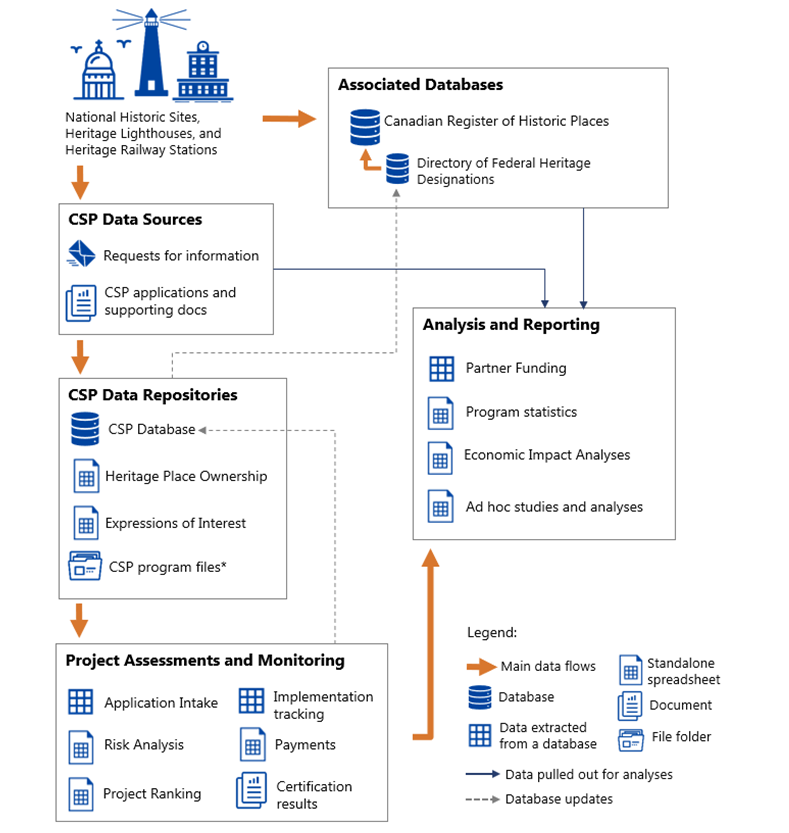
Text description
Flow chart tracing the intake and use of applicant data by the Cost-Sharing Program (CSP). The main sources of the data are requests for information about the CSP, and the applications submitted along with the supporting documents. These data flow from eligible national historic sites, heritage lighthouses, or heritage railway stations.
The main repositories of the data are the CSP database, a Heritage Place Ownership spreadsheet, an Expression of Interest Spreadsheet, and the CSP's program files.
Flowing from the repositories, data can be extracted into different formats and tools used to assess applications and then monitor the projects awarded funding. The CSP database is used to record and monitor Application Intake and track the implementation of projects. Risk analyses and risk scores are created by staff and save in a spreadsheet, project rankings are created and stored in a spreadsheet, payments are tracked in a spreadsheet, and certifications are tracked using reports.
At the analysis and reporting phase, info is extracted from the CSP database to report on funding, included what partner funding was contributed to the projects, as well as other program statistics as needed. Economic Impact Analyses are also conducted for the Program using expenditure data. Other studies and analyses may occur using the CSP database or other databases, such as the Canadian Register of Historic Places or the Directory of Federal Heritage Designations.
Note: This figure is not exhaustive. Assets like paper records, summaries for executives, and contribution agreements were omitted, as the analysis focused on data sets most relevant to evaluation themes.
Data review
Through a GBA Plus lens, data with which to measure differing needs and capacities among existing and potential applicants were available but limited.
While differing outcomes can be traced using administrative data, the ways in which sub-groups have been defined (primarily by type of organization) make it challenging to explore how or if varying capacity levels impact applicants' ability to secure CSP funding.
Needs and barriers
During key informant interviews, both the CSP staff and members of the Built Heritage team reported having a strong working knowledge of applicantsFootnote 4, their most common needs and the main challenges they face when trying to meet application requirements. Across all key informant interviews, participants agreed that CSP submission requirements are rigorous, and that the capacity to prepare strong proposals is not equally distributed among eligible applicants (see report section Applicant Capacities and Challenges).
Interview participants described differences in proposal writing skills, levels of administrative capacity, access to conservation expertise, comfort levels with technology, and both financial and project management experience. That said, when asked directly about any gaps in understanding applicant groups, program staff primarily pointed to eligible non-applicants, meaning custodians of heritage places that have never applied to, nor even enquired about the CSP, despite being eligible.
CSP and Built Heritage staff expressed curiosity and concerns about whether these non-applicants do not find the Cost-Sharing Program relevant to their needs, experience real or perceived barriers to applying, such as finding the requirements too onerous, or are simply unaware of the Program. Addressing this by reaching out to organizations is restricted both by anti-spam legislation, which limits unsolicited communication, as well as challenges in keeping contact information up to date, as there is no registry specific to owners or long-term custodians of national heritage places not administered by Parks Canada.
CSP staff maintain a spreadsheet listing contact info of known owners of eligible national heritage places; however, the data can quickly become obsolete when properties change ownership.
Defining capacity
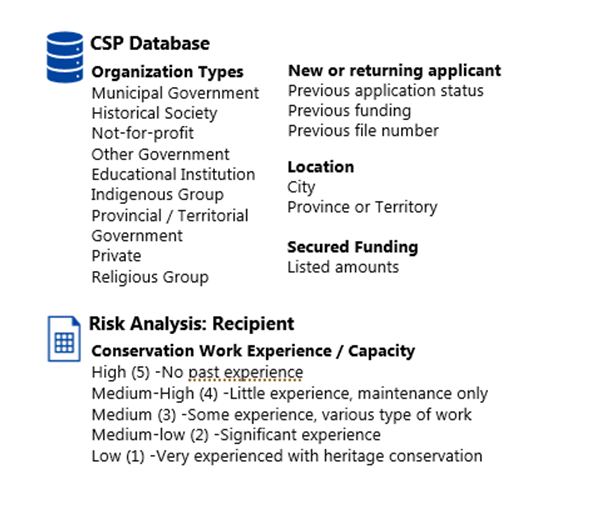
Data on applicants' capacity levels are collected in CSP submissions through written statements responding to questions about the threats facing the heritage structures, financial need and resources, and experience carrying out conservation work. The information collected is assessed by program staff and used to produce risk scores (see Fig. 4 on the following page) and contribute to overall project scores.
Defining group types
A key finding of the data review is the notable difference between how applicant groups were described during key informant interviews (as well as scoping interviews with Parks Canada executives) and the categories used to define and analyse groups across the CSP data repositories.
Interviewees shared a common vocabulary, describing applicants in terms of their organizations' size, capacity levels, and regional location. Most common were informal terms like "big" or "little" organizations and the use of opposing categories such as rural or urban, experienced or new to the Program, tech or non-tech savvy, and volunteer-based or staffed by professionals. Barring Indigenous organizations and geographic factors, identity-based categories commonly associated with GBA Plus were not frequently used, though some participants made references to marginalized or underrepresented groups.
In contrast to the interview results, the CSP database, the main source of data that can readily be used to find trends or explore outcomes, sorts cases by organization type as well as by city, province, previous submissions, project costs, awarded funding and secured funding. Capacity is defined only in the risk descriptors used for the Recipient portion of the risk analysis, which focused on conservation work experience (see Figure 4 below).
While the categories in the database relate to the ways interviewees grouped applicants, the data either require some additional transformations, such as re-coding city data to identify remote locations, or do not address key concerns, such as access to architects or other experts while preparing proposals.
Key findings
While both useful and meaningful in assessing proposals and managing the Cost-Sharing Program, analyses conducted by evaluators using the existing data sets suggest that the CSP may benefit from updated categories to allow the Program to more easily explore the impacts of differing needs or identify unintentional outcomes.
Text description
Indigenous stewardship of heritage places
Expectation: The Cost-Sharing Program is aligned with the Agency's goals related to Indigenous Stewardship and the United Nations Declaration on the Rights of Indigenous Peoples.
Recent updates to the Cost-Sharing Program's terms and conditions have better aligned the Program with the United Nations Declaration on the Rights of Indigenous People and with Parks Canada Indigenous Stewardship Framework.
These findings are addressed in Recommendation 1
Evidence used to consider the Cost-Sharing Program's alignment with Indigenous Stewardship goals consisted of a review of recent updates to the CSP, including terms and conditions, performance indicators, and pilot projects with Indigenous organizations. These were considered against the United Nations Declaration on the Rights of Indigenous Peoples (UNDRIP), Parks Canada's Indigenous Stewardship Framework and Parks Canada's Framework for History and Commemoration.
UNDRIP and Indigenous heritage
Within UNDRIP, articles 11, 12, 13, and 31 are specific in outlining Indigenous rights related to heritage. Looking to the past and to the future, the articles recognize the rights of Indigenous Peoples to preserve and create new forms of cultural heritage, to access and protect places of spiritual and religious significance, to transmit language, histories, and philosophies to future generations, and to develop, control and protect Indigenous heritage, traditional knowledge, and intellectual property (see Appendix 3). Part 1 of Article 11 contains the most specific reference to historic sites:
- Indigenous peoples have the right to practise and revitalize their cultural traditions and customs. This includes the right to maintain, protect and develop the past, present and future manifestations of their cultures, such as archaeological and historical sites, artifacts, designs, ceremonies, technologies and visual and performing arts and literature.
Part 2 of Article 11 describes states' responsibilities to provide redress "through effective mechanisms" for cultural, intellectual, spiritual, or religious properties taken without free, prior, and informed consent.
Indigenous stewardship framework
Within Parks Canada, the implementation of UNDRIP will be guided by the Indigenous Stewardship Framework. Recognizing that meeting UNDRIP requires a renewed vision of protected areas management and governance, the Framework articulates a set of core and enabling elements that are aligned with Indigenous ways of stewarding lands, water, and ice.
The four core elements of Indigenous stewardship (in green in Figure 5 below ) reflect what Parks Canada has heard from Indigenous Peoples about what is needed to support [re]connections with protected lands, waters, and ice within their traditional territories, treaty lands and ancestral homelands. The core elements are:
- Governance; meaning having a role in decision-making,
- Practices on land, water, and ice; having active relationships with these places through activities like monitoring, restoration, research, or harvesting,
- Indigenous knowledge systems: including the role played by Indigenous knowledge, values, and principles in helping to protect lands, waters, and ice for future generations,
- Economic opportunities: including ways Indigenous Peoples can benefit from natural and cultural heritage places
Three enabling elements (in blue) articulate foundational supports to Indigenous stewardship, i.e.:
- education and understanding regarding Indigenous Peoples' stewardship roles and responsibilities.
- working to build and maintain strong relationships between Indigenous Peoples and Parks Canada, and.
- the need to acknowledge and/or apologize in those places where past and/or present actions by Parks Canada have impacted Indigenous Peoples
Through their use, the core and enabling elements are expected to reshape Parks Canada policies and practices, aligning them with UNDRIP. While the core and enabling elements are both interrelated and mutually reinforcing, each also carries links to specific UNDRIP articles and to the themes present in the UN Declaration Act Action Plan (see Appendix 3).
Articles 11, 12, 13, and 31, which affirm rights related to cultural heritage, link most directly to Practices on Land and Indigenous Knowledge Systems, as well as the enabling element of Acknowledgements.

Text description
Visual summary of the Indigenous Stewardship Framework. A central ring of enabling elements carries the words Education and Understanding, Acknowledgements and Relationships. Another ring surrounds the first one and carries the words Indigenous Knowledge Systems, Shared Governance, Practices on the Land, Water, and Ice, and Economic Opportunities.
History and commemoration
Parks Canada's approach to heritage presentation and commemoration is guided by the Framework for History and Commemoration. Completed in 2019, it provides direction for the designation of heritage places, the management of historic sites administered by Parks Canada, and priorities for history presentation.
The history of Indigenous Peoples is one of four stated priorities (alongside environmental history, diversity, and Canada and the world) with commitments made to address legacies of colonialism, to present aspects of Indigenous history beyond interactions with the state and settlers, and to meet these goals through relationship building and active engagement. The Framework also features co-development of historical research and interpretation among its list of key practices, seeking to ensure that the voices of Indigenous People are better communicated to visitors at heritage places.
Document review
A review of the Program's recently updated terms and conditions provided evidence of efforts to align the CSP with UNDRIP.
Outcomes
Updates to the Cost-Sharing Program's terms and conditions were approved as part of a 2022 Treasury Board Submission for the Federal Framework to Address the Legacy of Residential Schools. Clear reference was made to UNDRIP in a new immediate outcome, stating:
- Funded activities at federally-recognized Indigenous Heritage Places support the right of Indigenous Peoples to maintain, protect and develop the past, present and future manifestations of their cultures as per the United Nations Declaration on the Rights of Indigenous Peoples.
This echoes UNDRIP article 11 and relates to the core element of Practices on Land (see Appendix 3).
Targets and indicators
While alignment with UNDRIP is not evident in the CSP's performance measurement strategy, the intermediate outcome tied to the program indicator does reflect elements from the Framework for History and Commemoration:
- The contributions of Indigenous Peoples to Canada's history are acknowledged and present in conversations about Canada's past.
The associated indicator is the percentage of funded CSP projects completed with Indigenous recipients, with a target of 13% by 2026, from a baseline of 4% set in the 2018-19 intakeFootnote 5. Results to date show progress against this target, aided by the creation of a series of pilot projects with heritage sites administered by Indigenous organizations. Program data show that projects by Indigenous recipients made up 7% of funded projects in 2022-23 and 10% in 2023-24.
Transfer payments
The updated terms and conditions also contain new transfer payment authorities for Indigenous recipients which provide access to grants as well as fixed, block or flexible contributions.
These funding tools, described in Appendix K of the Directive on Transfer Payments, are intended to support stable relationships with Indigenous governments and organizations by providing options for multi-year agreements, flexibilities in the timing and use of funds, and mitigating reporting burdens.
Pilot projects
Beginning in 2022-23, the Cost-Sharing Program has been piloting conservation and interpretation projects with national heritage places administered by Indigenous organizations.
Managed under the financial authorities of Parks Canada's General Class Contributions and Grants Program (GCGCP) as the CSP works towards implementing new program tools and formally creating a fourth stream for Indigenous Heritage Places, a stated objective of the pilots was to better understand the needs of this segment of eligible recipients to the Cost-Sharing Program. Two intake cycles have been completed, with three initial projects in 2022-23 and four in 2023-24.
Important aspects of the pilot projects as identified by CSP staff include the use of the GCGCP's more flexible funding options, the ability to fund more than 50% of costs, and the ability to support activities identified by Indigenous partners that do not necessarily meet the Standards and Guidelines for the Conservation of Historic Places in Canada.
In these broad terms, the pilots align with UNDRIP Article 11, and elements of the Indigenous Stewardship Framework related to relationship building and practices on land. The pilot projects also resonate with findings from a 2022 report on Indigenous Heritage and UNDRIP by the Indigenous Heritage CircleFootnote 6, highlighting the need for financial supports as well as giving communities control of their heritage resources to help preserve and revitalize Indigenous heritage.
Key findings
The review of the Cost-Sharing Program's updates to its terms and conditions, as well as the pilot projects at national heritage places indicate that the CSP is creating tools and processes that will help it meet its stated outcomes related to UNDRIP and align itself with Parks Canada's goals related to Indigenous stewardship. That said, these findings do not speak to the impacts nor the effectiveness of these changes to the CSP.
Moreover, the Program's current key program indicators, which focus on numbers of projects certified and the proportion of projects completed with Indigenous partners (see Program Profile), do not yet relate to Indigenous stewardship elements or reference the UNDRIP articles used to formulate the immediate result that the CSP will "support the rights of Indigenous People to maintain, protect and develop the past, present and future manifestations of their cultures".
Key Findings: effectiveness
| Expectations | Findings |
| 1. Application processes are similar to those of other programs with comparable goals | Benchmarking of comparable programs found that application processes were aligned with other built heritage funding programs. |
| 2. Applicant groups perceive the Cost-Sharing Program's processes and requirements as reasonable | A survey of Program applicants found that most participants perceived submission guidelines as clear and processes as largely reasonable. Challenges were identified in relation to project deadlines and differing levels of access to conservation expertise among applicants. |
| 3. Challenges or barriers experienced by applicants have been identified by the Cost-Sharing Program | Cost-Sharing Program staff and members of the Executive Review acknowledged the rigorous nature of application requirements and reported observing challenges for applicants in areas of conservation expertise, financial capacity, and project management capacity. |
| 4. The Cost-Sharing Program's processes and guidelines provide mechanisms to minimize barriers for eligible applicants. | Pilot projects for a new program stream for Indigenous governments and organizations provided a clear example of mechanisms created to minimize barriers. Beyond Indigenous applicants, some flexibilities in the application of the Program's selection criteria were also identified, which staff can leverage during the review process. |
Application processes
Expectation: Application processes are similar to those of other programs with comparable goals
Benchmarking found that the Cost-Sharing Program's application requirements and processes were similar to those of other heritage conservation funding programs.
Evidence of the alignment of the CSP application process and requirements to those of programs with similar goals was gathered through a benchmarking exercise.
Benchmarking
Benchmarking provided comparative information on application requirements as well as guidance and supports. Eight programs were included in the review, including three supporting Indigenous heritage (see Appendix 2):
- Building Communities Through Arts and Heritage
- Heritage Legacy Fund (British Columbia)
- Canada Cultural Spaces Fund
- Capital Facilities and Maintenance Program
- Heritage Infrastructure Program (First Peoples' Cultural Council)
- Museum Assistance Program (Indigenous Heritage)
- Na-mi-quai-ni-mak Community Support Fund
- National Trust Launch Pad.
Application requirements
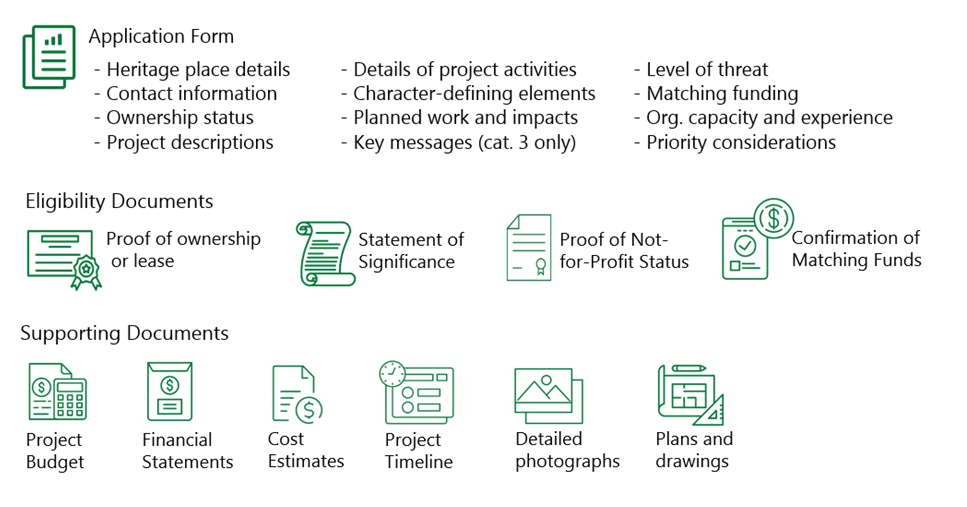
In all reviewed cases, application forms requested information on project goals, scope, budget, and timelines, as well as descriptions of organizations' financial resources. Programs focused primarily on conserving built heritage, such as the Cost-Sharing Program and the Heritage Legacy Fund, required a variety of additional and detailed information such as proof of ownership or partnership with owners, financial statements, detailed photographs, site plans, conservation reports, statements of significance and/or detailed descriptions of the heritage components, planned interventions, and demonstration of the ability to carry out the work (see Figure 6 below).
Programs whose scope included larger construction or renovation projects, such as the Canada Cultural Spaces Fund, also requested cost estimates, and in some cases insurance documentation and proof of approvals by local governing bodies, including Indigenous governments. Letters demonstrating community engagement were also commonly requested, though not by the CSP.
Smaller-scale programs, such as the National Trust Launch Pad and the Na-mi-quai-ni-mak Community Support Fund, which respectively fund coaching grants and community-based remembrance projects, featured simpler forms and limited supporting documentation. Both also accepted applications on an ongoing basis, rather than in yearly intakes. The Na-mi-quai-ni-mak Community Support Fund also offers to receive applications via interviews, and in applicants' own Indigenous language.
Application supports
Written guidelines including key steps, instructions, and explanations of program elements were available online for each program. Federal funding programs shared very similar guideline structures on their websites, with some variation in terms of submission mechanisms, ranging from paper to online portals. Heritage conservation and infrastructure programs also encouraged (or required in the case of the BC Heritage Legacy Fund) applicants to contact staff in advance to confirm eligibility and respond to questions.
While the larger federal programs offered a generic email address and phone line for questions, smaller organizations provided a named contact person with a specific email address. Other common tools offered by the built heritage programs, including by the CSP, were sample budgets, worksheets, and checklists of required documents.
Key findings
While examples of simpler processes were identified, programs with similar aims and scope to the CSP were found to have comparable requirements and supports. This suggests that application requirements are proportionate to the CSP's information needs.
Text description
Applicant capacities and challenges
Expectation: Challenges or barriers experienced by applicants have been identified and documented by Cost-Sharing Program staff.
Evidence indicates that CSP program staff are aware of existing barriers. Results from a survey of past applicants provide additional analysis and considerations.
Findings from this section are addressed in Recommendation 2.
Evidence used to consider the Cost-Sharing Program's effectiveness at identifying and minimizing barriers for eligible applicants include key informant interviews and survey of past CSP applicants. Benchmarking results and program data also informed the analysis.
Identifying barriers
Reviews of applicant records and administrative data completed in the early phases of the evaluation noted that while program staff had a strong sense of the challenges and barriers affecting different applicant groups, analyses of program outcomes were not able to account for differences in applicants' capacity levels.
Perceived applicant challenges
A central theme that emerged out of the key informant interviews was the question of how best to balance the Cost-Sharing Program's aim to fund projects with the most robust proposals, which provide assurance that work will be completed on time and to national heritage conservation standards, with its commitment to support those heritage places most in need of help.
As such, while the CSP and Built Heritage staff broadly agreed that application requirements were already pared down to their necessary (though still extensive) elements, they also acknowledged that the process is challenging, especially for "small organizations", i.e., those seen as having limited financial, administrative, conservation, and/or project management capacity.
As such, a key concern among interviewees is that, without mechanisms to balance the outcomes, uneven capacity levels among applicants would create outsized advantages for better resourced organizations, both in terms of scoring well against the CSP's selection criteria and in being able to finish the work and achieve project certification within the Program's timelines. CSP administrative data, specifically records from previous intake cycles, do indicate that some group types are more successful than others at receiving funds from the CSP.
Outcomes by sub-groups
This section presents results from analyses of two existing CSP applicant categories, organization types and location of heritage sites by province or territory. The main metric identified by evaluators for measuring outcomes was application funding success rates, meaning the number of successful applications from a given sub-group or applicant type relative to the total number submitted over a given period.
Success rates used in this section of the report were generated from administrative data covering the period between 2017 to 2023. In that timeframe, the Cost-Sharing Program funded an average of 57% of the eligible applications it received.
Organization types
Table 6 presents the funding success rates by CSP organization types. With a total of 94 submissions over the evaluation period, not-for-profit organizations are the largest single applicant group, with a success rate of 50%.
| Organization Type | Eligible Applications | Success Rate |
|---|---|---|
| Indigenous governments or organizations | 11 | 91% |
| Religious groups | 47 | 70% |
| Provincial or territorial governments | 12 | 67% |
| Educational institutions | 8 | 63% |
| Historical societies | 38 | 58% |
| Municipal governments | 44 | 55% |
| Not-for-profit organizations | 94 | 50% |
| Other governments | 9 | 33% |
| Total/Average | 263 | 57% |
Note: The calculation of the average success rate excluded the seven Indigenous pilot projects, although their inclusion only brings the average success rate to 58%
Due to the recent pilot projects encouraging more applications, Indigenous governments or organizations hold the highest success rate of 91%. That said, before the initial pilot in 2022-23 submissions to the Cost-Sharing Program by Indigenous organizations did not surpass one per year, or roughly 2% of all submissions received. With a total of seven funded projects over the past two years, the proportion of applications from Indigenous organizations rose to 10% in 2023-24.
After not-for-profit organizations, religious groups, municipal governments, and historical societies account for the majority of the remaining submissions, with religious groups having the highest funding rate of 70%. The only group falling well below average for successful proposals is the small number of submissions by "other governments" (e.g., non-federal parks commissions or heritage trusts).
Province or Territory Explored by province or territory, submissions and funding success rates vary considerably. As summarized in Table 7, Nova Scotia recorded the highest rate, at 78%, and Prince Edward Island the lowest, though with only two submissions in total. The largest number of submissions overall came from Québec, with a total of 90, followed by Ontario at 45, and British Columbia at 30; of these, British Columbia held the highest success rate at 63%.When grouped by regions, success rates fell much closer to the overall average of 57%, with 59% in the Atlantic region, 58% in Québec, 57% in the Prairies, 52% in British Columbia and the Yukon, and 49% in Ontario.
Table 8 compared the percentages of applications received from each province or territory with the percentage of federally designated heritage places located in those regions, according to the Directory of Federal Heritage Designations as of January 2024.
Application percentages align closely to their provincial and territorial distribution, apart from Ontario and Québec, which are respectively under and over-represented in the total pool of eligible applications.
| Province or Territory | Eligible Applications | Success Rate |
|---|---|---|
| Nova Scotia | 27 | 78% |
| Alberta | 15 | 73% |
| Yukon | 3 | 67% |
| British Columbia | 30 | 63% |
| Manitoba | 16 | 63% |
| Québec | 90 | 58% |
| New Brunswick | 8 | 50% |
| Ontario | 45 | 49% |
| Newfoundland | 12 | 42% |
| Saskatchewan | 15 | 40% |
| Prince Edward Island | 2 | 0% |
| Total/Average | 263 | 57% |
| Province or Territory | % of Eligible Applications | % of Federal Designations |
|---|---|---|
| Alberta | 6% | 6% |
| British Columbia | 11% | 10% |
| Manitoba | 6% | 6% |
| New Brunswick | 3% | 6% |
| Newfoundland | 5% | 5% |
| Northwest Territories | - | 1% |
| Nova Scotia | 10% | 10% |
| Nunavut | - | 1% |
| Ontario | 17% | 27% |
| Prince Edward Island | 1% | 3% |
| Québec | 34% | 20% |
| Saskatchewan | 6% | 5% |
| Yukon | 1% | 1% |
Survey of CSP applicants
While the data analyzed on the previous pages identified some trends in application success rates relative to organization types and the location of the heritage places, it is difficult to extract more meaning from the data without relying on other lines of evidence, primarily key informant interviews with program staff, to point out likely underlying causes.
To help address this, evaluators conducted a survey of eligible organizations that had submitted at least one application during the evaluation period, i.e. between 2017-18 and 2022-23.
Questions sought to understand organizations' resources and capacities as well as their experiences preparing and submitting applications to the Cost-Sharing Program.
Dimensions of capacity explored were largely derived from interviews and consultations with CSP staff, falling into four main areas:
- Access to conservation expertise,
- Human resources/ administrative capacity,
- Financial resources and ability to access funding,
- Project planning and timeliness
A summary of results from the applicant survey are presented below. Data collection took place between November 8 and December 4, 2023.
Staffing
Just over half of the applicant organizations reported having both paid staff and volunteers. This translates to 81% of organizations having volunteers in at least some roles, and 29% being fully volunteer run. Among organizations with volunteers, the majority (79%) reported that volunteers were involved in the management of their sites.
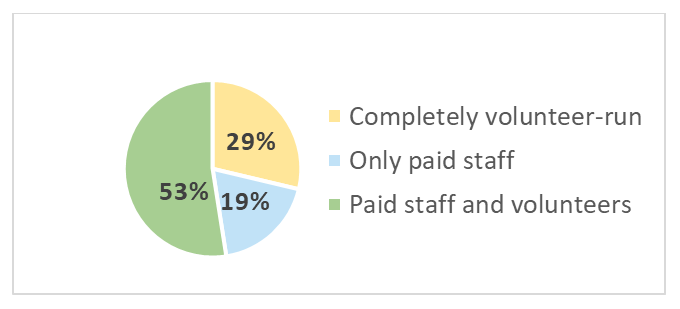
Text description
Pie chart showing that the majority of applicant organizations (53%) are staffed by a mix of volunteers and paid staff.
Access to experts
In terms of the technical expertise needed for conservation projects, i.e., architects, skilled tradespeople, or conservators, half the sample could hire or consult with experts as required, while 36%, or over one-third, said they had limited or little to no access to technical experts. Only 14% could access in-house experts, primarily paid staff or board members, though a small proportion also listed volunteers.

Text description
Pie chart showing that half of applicant organizations can hire or consult experts, while 36% have little to no access.
Most organizations drew their funding from several sources. For regular operations, more commonly reported sources were grants and contributions, followed by fundraising activities. Less than half of the organizations said they receive ongoing funding from any level of government, and fewer still (20%) fund their operations through their own revenue.
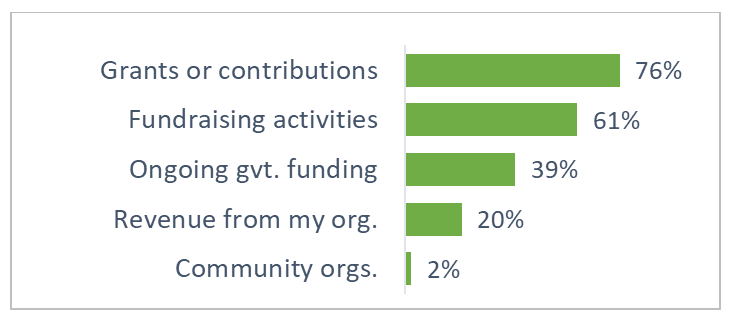
Text description
Bar chart showing that the most common source of operating funds among applicant organizations are grants and contributions, at 76%.
In terms of funding conservation projects, 85% of organizations stated they had to obtain grants or contributions to get the work completed, while almost half said they must conduct fundraising activities. A little more than one-third can fund some projects using their own financial resources. Over half of the respondents (56%) reported accessing at least two of the listed funding sources for their most recent project, typically a mix of grants or contributions, and additional fundraising.
Note: Data in Figures 9 and 10 were gathered using multiple response questions. Reported numbers may total more than 100%
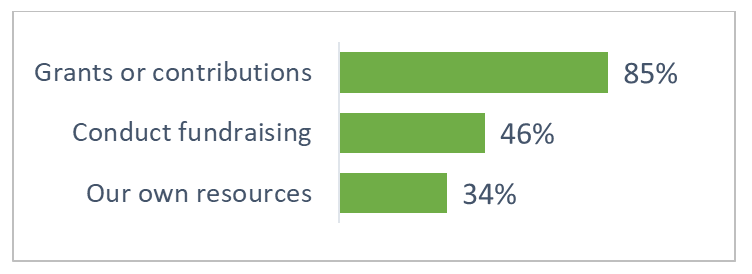
Text description
Bar chart showing that the largest source of project funding among applicant organizations are grants and contributions at 85%
To meet the Cost-Sharing Program's 50% threshold, almost half of the organizations need to draw on other sources, such as partners or other granting programs, while 37% said they need to carry out additional fundraising activities. Only 17% reported that they were able to use their own internal funds.
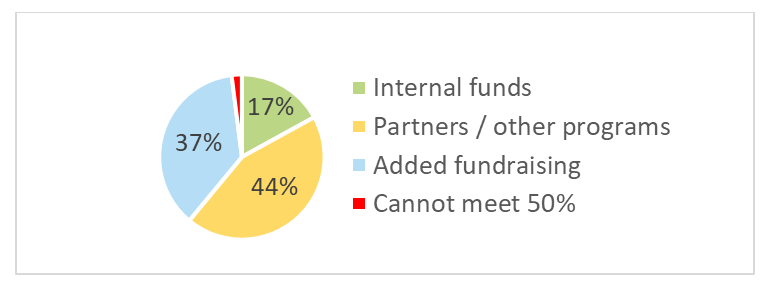
Text description
Bar graph comparing the percentages of staff involved in application in organizations with and without volunteers. Volunteers are overall less likely to contribute to applications.
Preparing applications
Within organizations with both paid staff and volunteers, paid staff were more often involved in application development, with 42% reporting that no volunteers had been involved.
In terms of the number of individuals involved, most organizations reported that between one and five staff (paid or volunteers) had contributed to the preparation of their most recent CSP application.
During the development of their most recent application, 58% of the organizations reported that they had reached out to Parks Canada staff for support. Within that sub-group, most felt program staff had been helpful (35%) or very helpful (44%).
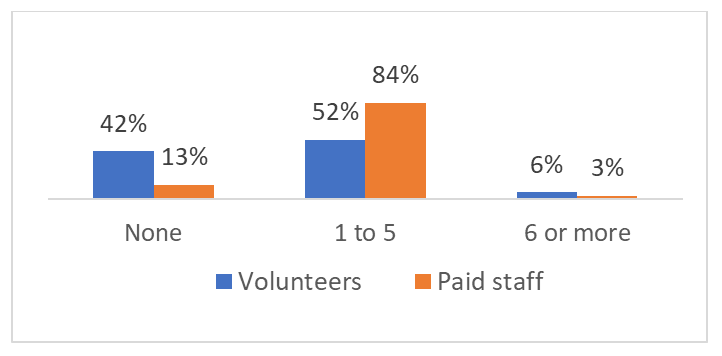
Text description
Bar graph comparing the percentages of staff involved in application in organizations with and without volunteers. Volunteers are overall less likely to contribute to applications.
Time and timelines
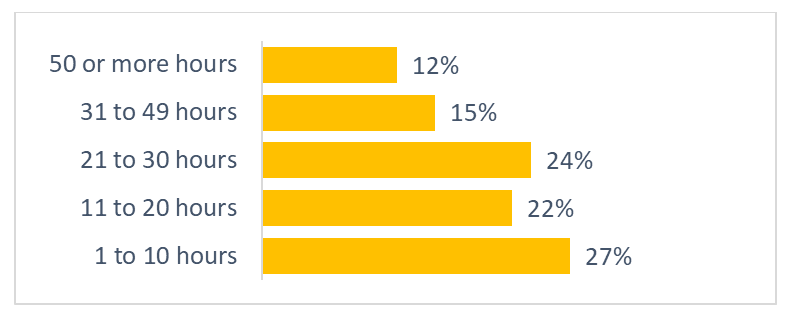
Survey participants reported that completing their most recent Cost-Sharing Program application had required an average of 26 hours, with total reported times ranging from less than ten to a maximum of 85 hours. Roughly half the sample reported their last application had required more than 20 hours to complete.
Text description
Bar graph summarizing reported time spent preparing applications. Half reported needing more than 20 hours, while 12% reported needing more than 50.
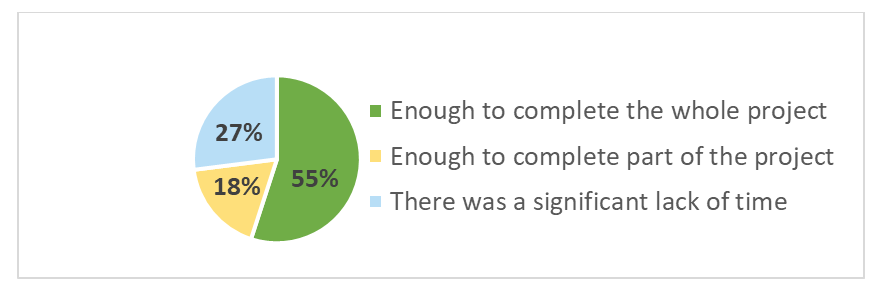
Survey questions also addressed the amount of time given to funded organizations to complete the conservation work. While over half indicated that there was enough time, almost a third of the organizations, or 27%, indicated that there was a significant lack of it. The remaining 18% reported having enough time to complete a portion of the work.
Text description
Pie chart showing applicants' perceptions of the time allotted to complete projects, with 45% reporting there was not enough time.
Conservation planning
When it comes to undertaking conservation work, half of the surveyed organizations said they make plans for conservation projects ahead of time, while relatively few (12%) said they conduct investigations in advance of any interventions at their site.
Most of the organizations also indicated that they only undertake projects they can finance and delay the ones they cannot. Among the organizations that were unsuccessful in at least one application to the Cost-Sharing Program, 57% reported finding other sources of funds, while 43% indicated that the project did not proceed.
| Conservation Planning | % |
|---|---|
| We undertake only those projects that we can finance and delay projects that are too costly | 66% |
| We make plans for our conservation projects ahead of time | 51% |
| We mostly undertake temporary repairs while we wait to complete the full intervention | 41% |
| We undertake multiple investigations in advance of any interventions | 12% |
Application process ratings
Organizations' perspectives on the application process were measured using five statements focusing on:
- the effort required to complete the application.
- the amount of documentation needed in submissions.
- the sufficiency of time given to prepare CSP applications.
- the time between submission and being notified of results; and,
- the clarity of the CSP's application guidelines
Figure 15 presents the ratings given to each of the five statements. Agreement levels were highest for the clarity of application guidelines, with 72% in the top category and only 5% disagreement. This is followed by "Amount of supporting documentation was reasonable" with 61% of respondents in agreement and 17% in disagreement.
The three remaining statements, which address the time given to complete the application, the amount of effort needed, and the timeframe for notification, have similar profiles in terms of positive responses, with agreement above 50% in each case. That said, all three statements also carry a significant proportion of disagreement. For "Effort required to fill out the application was reasonable" 22% of organizations disagreed, and 24% were in the neutral category.
Both items related to timelines, i.e., submission deadlines and the timeliness of funding notification, are polarized, meaning a higher proportion of respondents are at either ends of the scale, suggesting a stronger divergence in applicants' perceptions or experiences.

Text description
Bar chart summarizing respondents' agreement with five statements about the Cost-Sharing Program.
Application guidelines were clear: 72% agree, 24% neutral, 5% disagree
Amount of supporting documentation was reasonable: 61% agree, 22% neutral, 17% disagree
Enough time was given to complete the application: 57% agree, 15% neutral, 28% disagree
Effort required to fill out application was reasonable: 54% agree, 24% neutral, 22% disagree
Was informed of funding in a reasonable timeframe 51% agree, 17% neutral, 32% disagree
Note: Survey questions used a 5-point scale (Strongly agree; Agree a little; Neutral; Disagree a little; Strongly disagree). Agree and disagree responses were combined for Figure 15
Key Findings
These results suggest that application requirements are largely clear and that needed efforts are seen as reasonable to a little over half of the surveyed organizations. Time-related items, while rated positively by half of the respondents, were most likely to seem problematic to applicants. Overall, CSP processes and requirements appear to be challenging to roughly 20% to 30% of the organizations who submitted applications over the evaluation period.
Applicant Survey Analysis
Beyond the summaries provided above, analysis of survey data mainly consisted of exploring potential patterns or connections between the descriptive data and the rating questions.
Survey data were also linked to selected CSP administrative data to allow for a more fulsome exploration of possible impacts and outcomes.
Data matched to the survey results included CSP organization types, provincial or territorial location, and application history for the evaluation period, i.e., between 2017 and 2023. This allowed for analysis of funding success rates comparable to those presented in Tables 7 and 8.
That said, it is still important to note that statistical analyses were limited by the size and the non-random nature of the sample (59 out of a possible 142 organizations responded, which creates a theoretical error rate of ±9.8% at the 95% confidence interval). Whenever possible, efforts were made to triangulate findings with other lines of evidence.
Timelines
Questions related to time in the applicant survey indicate that a segment of the organizations who apply to the Cost-Sharing Program experience difficulties with meeting the Program's various deadlines. Among the rating questions represented in Figure 15 above issues related to time allotted, both for prepping applications and receiving notifications, were the most polarized and featured the highest levels of disagreement. A significant proportion of respondents (27%) also felt that timelines related to completing conservation projects were insufficient.
These results echo other findings. The benchmarking exercise found that the Program's published timelines for conservation work were shorter than that of the other reviewed programs (see Appendix 2). Some interviewees also signaled concerns with the CSP's more compressed work time, though others noted that the Program does grant extensions, mostly between one or two months, when necessary.
Finally, a portion of interviewees also noted that launch dates for some of the more recent intake cycles had been delayed or somewhat irregular due to challenges with approvals or other factors internal to Parks Canada.
Access to technical conservation expertise
Table 10 below shows cross-tabulations of access to technical expertise against the rating item "The effort required was reasonable". An evident contrast can be seen between organizations with and without access to conservation expertise, with agreement levels ranging from 75% among those with in-house experts to 38% among those with little access to conservation expertise.
| Effort was Reasonable | Agree | Neutral | Disagree | Total |
|---|---|---|---|---|
| Organization has in-house technical experts | 75% | 0% | 25% | 8 |
| Organization can hire or consult experts as needed | 60% | 23% | 17% | 30 |
| Organization has limited to no access to experts | 38% | 33% | 29% | 21 |
Table 11 also focuses on access to technical expertise, but in relation to funding success rates. Organizations with in-house technical experts are shown to have a success rate of 70%, while those with limited to no access register a rate of 50%, falling below the overall average success rate among survey participants of 60%.
| Total Applications | Count of Funded | Success Rate | |
|---|---|---|---|
| Organization has in-house technical experts | 20 | 14 | 70% |
| Organization can hire or consult experts as needed | 62 | 39 | 63% |
| Organization has limited to no access to experts | 36 | 18 | 50% |
| Total/Average | 118 | 71 | 60% |
Staffing composition
Like access to expertise, staffing composition, meaning whether teams are composed exclusively of paid staff, of volunteers, or of both, appeared to relate with elements of survey data as well as selected administrative data. Table 12 presents the estimated hours required to complete a recent CSP application. Organizations with a mix of paid staff and volunteers reported an average of 26 hours, while groups with paid staff reported just under 19 hours. Volunteer-run groups reported the longest amount of time, just over 30 hours.
| Average Hours | |
|---|---|
| Volunteer-run | 30.2 |
| Paid staff and volunteers | 26.2 |
| Only paid staff | 18.9 |
Table 13 shows another instance of varying application success rates, though in this instance the differences seem to align with staffing composition. Organizations with only paid staff had the highest rate, at 68%, followed by those with paid staff and volunteers. Volunteer-run organizations were below average, with a success rate of 53%.
| Total Applications | Funded | Success Rate | |
|---|---|---|---|
| Only has paid staff | 22 | 15 | 68% |
| Paid staff and volunteers | 66 | 40 | 61% |
| Completely volunteer-run | 30 | 16 | 53% |
| Total/Average | 118 | 71 | 60% |
Capacity and organization types
Lastly, Table 14 illustrates some limitations of organizational types as a means of exploring barriers or unexpected outcomes, by cross tabulating access to expertise and the group types from CSP administrative data.
While only three types, not-for-profits, historical societies, and religious groups, make up the sub-set of applicants without access to experts, which could suggest they are at a disadvantage, the same types also figure (in lesser or greater numbers) among those with the ability to consult with experts as needed. This highlights the usefulness of data exploring different aspects of capacity in drawing more accurate portraits of applicants and applicant sub-groups.
Key Findings
For the most part, survey findings aligned with the challenges and barriers perceived and reported by key informants. In particular, survey data suggest that access to technical conservation expertise and staffing composition influence how the application process is experienced and impact the likelihood that proposals will be funded. Staffing composition also seems to influence the average time needed to complete proposals, with volunteer run groups reporting an average of 30 hours.
| My organization can hire or consult with outside experts as needed | Count | % of group |
|---|---|---|
| Religious Group | 9 | 30% |
| Historical Society | 6 | 20% |
| Not-for-profit | 6 | 20% |
| Municipal Government | 4 | 13% |
| Educational Institution | 2 | 7% |
| Indigenous Organization | 1 | 3% |
| Other Government | 1 | 3% |
| Provincial / Territorial Government | 1 | 3% |
| Sub-total | 30 |
| My organization has in-house technical experts (paid or volunteers) | Count | % of group |
|---|---|---|
| Historical Society | 3 | 38% |
| Indigenous Organization | 1 | 13% |
| Municipal Government | 1 | 13% |
| Not-for-profit | 1 | 13% |
| Other Government | 1 | 13% |
| Religious Group | 1 | 13% |
| Sub-total | 8 |
| My organization has limited to no access to technical experts | Count | % of group |
|---|---|---|
| Not-for-profit | 14 | 67% |
| Historical Society | 4 | 19% |
| Religious Group | 3 | 14% |
| Sub-total | 21 |
Minimizing barriers
Expectation: The Cost-Sharing Program's processes and guidelines provide mechanisms to minimize barriers for eligible applicants.
Evidence indicates that flexibilities in program structures can be used to minimize barriers for applicants.
Evidence used to consider the Cost-Sharing Program's approach to minimizing barriers for eligible applicants are primarily drawn from key informant interviews with Program staff, members of the Built Heritage team, and members of the CSP's Executive Review Committee. These are supported by a review of program guidelines.
Current Mechanisms
Key informant interviews indicated that the existing mechanisms for minimizing applicant barriers to the Cost-Sharing Program are primarily found in the application review process, in the interpretation of selection criteria, and in the application supports provided to applicants during the submission development stage.
Supports and Relationship Building
CSP and Built Heritage staff highlighted relationship building as an aspect of the pre-application/application process that was particularly effective and useful. Staff valued their ability to advise applicants at different points in the program's cycle; reporting that the quality of proposals and the resulting projects were significantly better when a relationship had been developed.
Survey results appear to support this, as most (79%) of the applicants who reported consulting with program staff found the support received either helpful or very helpful.
Review Process
There was agreement among participants that the CSP's current application review process is largely effective and aligns with the program's objectives. Participants described the discussion-based review processes (see Figure 1) as fair and rigorous, in that guidelines were consistently applied by staff with appropriate expertise.
Interviewees who had been members of the executive review committee, while more likely to be critical of the selection criteria and application requirements, also felt that the review process allowed for different "lenses" to be applied to the funding decisions, particularly in terms of regional differences and differences in the capacity levels of applicant organizations.
Selection criteria
Application scores are based on five criteria including level of threat, the suitability of proposed mitigations, adherence to conservation standards, financial need and financial risk levels, and project delivery capacity.
While interview participants agreed that criteria such as adherence to standards, project delivery, and the suitability of prosed actions favour better-resources applicants, it was noted that demonstrated need as well as level of threat can form the basis of funding less complete submissions, typically by establishing requirements to be met before starting to transfer funds, mitigating project risks.
Alongside the ability to apply different "lenses" during the review process noted on the previous page, this usage of selection criteria was felt to bring a level of flexibility to the Cost-Sharing Program, which could then be used to minimize barriers for a portion of applicants.
Some interview participants also pointed to newer application guidelines which state that proposals related to climate change, underrepresented communities, or accessibility may be prioritized as another means of minimizing barriers. As noted earlier in this report these changes are too recent to assess impacts on application trends.
Pilot projects
The strongest example, according to most interview participants, of minimizing barriers to the CSP are the recent pilot projects with Indigenous governments and organizations, which created flexibilities in terms of eligible expenses and activities as well as funding options via transfer payment authorities specific to Indigenous partners. As highlighted by Table 15, the impacts of these changes on the number of applications received from Indigenous organizations has been clear.
Key Findings
While the impacts of the mechanisms identified through interviews with program staff are difficult to assess at present, evidence suggests that existing flexibilities help some applicants requiring more support to access CSP funding. Early analyses of the pilot projects with Indigenous partners suggest that added flexibilities are having a positive impact on the number of completed projects.
| Type of Organization | PR/ TY | 17-18 | 18-19 | 19-20 | 20-21 | 22-23 | 23-24 |
|---|---|---|---|---|---|---|---|
| First Nation | SK | ✓ | |||||
| Indigenous group | BC | ✓ | ✓ | ✓ | ✓ | ||
| Indigenous group | BC | ✓ | |||||
| Indigenous group | BC | ✓ | X* | ||||
| Indigenous not-for-profit | BC | ✓ | |||||
| Indigenous not-for-profit | NS | ✓ | |||||
| Indigenous not-for-profit | QC | ✓ | |||||
| Indigenous not-for-profit | BC | ✓ |
Note: X indicates a submission that was not funded.
Recommendations and management responses
Recommendation 1
The Vice-President, Indigenous Affairs and Cultural Heritage, should review and adjust program metrics and performance measures of the National Cost-Sharing Program for Heritage Places with particular consideration given to:
- Creating key program indicators aligned with elements of Parks Canada's Indigenous Stewardship Framework and the United Nations Declaration on the Rights of Indigenous People
- Collecting applicant information relevant to capacity levels, allowing the Cost-Sharing Program to better identify unintended outcomes and monitor the effectiveness of mechanisms designed to minimize barriers.
For key findings related to the above recommendation, please refer to the following sections of the report:
- Indigenous Stewardship of Heritage Places
- Relevance Across Applicant Groups
- Applicant Capacities and Challenges
Management response
Agreed. The Indigenous Affairs and Cultural Heritage Directorate will conduct a review of key metrics and program indicators to identify necessary changes to better align with Parks Canada's Indigenous Stewardship Framework and the United Nations Declaration on the Rights of Indigenous People Act and to address issues related to varying applicant capacity levels.
| Deliverables | Timeline | Responsible position |
| 1.1 Review of the program's logic model and performance measures. | March 2026 | Director, Cultural Heritage Programs |
| 1.2 Review of the data collected by the program related to applicant capacity levels. | March 2025 | Director, Cultural Heritage Programs |
| 1.3 Implement changes resulting from 1.1 and 1.2. | March 2026 | Director, Cultural Heritage Programs |
Recommendation 2
The Vice-President, Indigenous Affairs and Cultural Heritage, should review and adjust timelines of the National Cost-Sharing Program for Heritage Places with consideration given to better aligning project delivery deadlines with those of comparable funding programs.
For key findings related to the above recommendation, please refer to the following sections of the report:
- Program Structures and Best Practices
- Applicant Capacities and Challenges
Management response
Agreed. The Indigenous Affairs and Cultural Heritage Directorate will conduct a review of key metrics and program indicators to identify necessary changes to better align with Parks Canada's Indigenous Stewardship Framework and the United Nations Declaration on the Rights of Indigenous People Act and to address issues related to varying applicant capacity levels.
| Deliverables | Timeline | Responsible position |
| 2.1 Review of possible mechanisms to extend project delivery timelines. | March 2025 | Director, Cultural Heritage Programs |
| 2.2 Implement changes based on the results of the review from 2.1. | March 2027 | Director, Cultural Heritage Programs |
Appendix 1 Evaluation methods
Methods
This section provides additional details on the methods used to form the evaluation's lines of evidence, which included data and document reviews, key informant interviews, data mapping, data analysis, a benchmarking exercise, and a survey of Cost-Sharing Program applicants.
Applicant Survey
A survey of past applicants (2017-18 to 2022-23) to the Cost-Sharing Program was conducted for the evaluation by PRA Inc. Both successful and non-successful applicants were invited to participate. Parks Canada provided PRA with a list of 142 organizations to contact via email. Email invitations were distributed on November 8, 2023, followed by up to four reminder emails to non-responders. The survey was closed on December 4, 2023, receiving feedback from 59 organizations, resulting in a response rate of 42% and a theoretical error rate of ±9.8% at the 95% confidence interval.
Data Analysis
Program data analyzed included financial records and administrative information collected by CSP staff and maintained in the Cost-Sharing Program's database, such as organization types, location, and funding outcomes from all intake cycles falling within the evaluation period (2017-18 and 2022-23).
Selected fields from the CSP database were linked to survey data by PRA Inc. who were provided with contact details allowing for the two datasets to be matched. The linked dataset was used to explore trends in application approvals in particular.
Key Informant Interviews
Semi-structured interviews were conducted with Cost-Sharing Program staff, members of the Built Heritage team, and members of the Cost-Sharing Program's executive review committee. Coding of participants' transcripts and analyses of interview themes were completed using QDA Miner qualitative analysis software.
Benchmarking
Benchmarking is the process of comparing a program to an appropriate comparison, such as an industry standard or a similar program. Programs included in the analysis were identified via the National Trust for Canada's Find Funding database. An initial list was generated by searching for national, provincial, and territorial-level programs focused on "bricks and mortar" projects. Eight programs were retained for their relevance to evaluation themes and questions (see Appendix 2). Data collection and analyses relied on publicly available information from programs' websites.
Document Review
Reviewed program documents included application materials, terms and conditions, and program guidelines. A review of documents related to UNDRIP, Indigenous stewardship, and Indigenous cultural heritage were used to support the analysis of new program components.
Data Mapping
A data mapping process was used to trace applicant data from their sources through various datasets and data repositories. Steps included:
- identifying the scope and boundaries of the data and systems reviewed,
- listing all data repositories, databases, applications, and file systems where data is stored,
- categorizing the results into data types,
- tracing how data moves between systems and users, to help understand inputs, and transformations, and,
- mapping the connections between different data elements, showing how they relate or interact with each other.
Appendix 2 Benchmarking study
| Program Name | Contribution Limits |
|---|---|
| Building Communities Through Arts and Heritage Program (Legacy Fund) | Grants $100 000 Contributions $500 000 |
| Canada Cultural Spaces Fund | Feasibility $500,000 Construction $15,000,000 Equipment $5,000,000 |
| Capital Facilities and Maintenance Program | Under $1.5 million for minor capital projects Over $1.5 million for major capital projects |
| Heritage Infrastructure Program | Planning $5,000 Conservation $50,000 Awareness $10,000 Indigenous Partnership $7,500 |
| Heritage Legacy Fund –British Columbia | $250,000 |
| Launch Pad -National Trust for Canada | In-kind counselling |
| Museum Assistance Program - Indigenous Heritage | $200,000 |
| Na-mi-quai-ni-mak Community Support Fund | $10,000 |
| National Cost-Sharing Program for Heritage Places | Preparatory $25,000 Conservation $250,000 Presentation $25,000 |
Descriptions of reviewed programs
Building Communities Through Arts and Heritage Program (Legacy Fund)
The Program celebrates and commemorates community history, heritage, and local arts through various grants and contribution streams. Within the broader program, the Legacy Fund provides funding for community-initiated capital projects that restore, renovate, or transform an existing building or space intended for community use.
Eligible Recipients
Local non-profit organizations, Indigenous governments or organizations, municipal administrations, boards, and commissions that demonstrate an active partnership with at least one community-based group for the purposes of the proposed project.
Application Requirements
The Legacy Fund Budget; proof of the anniversary date; copies of letters patent and/or documents of incorporation; organizational by-laws; copies of recent financial statements (audited if available); and documentation of ownership, long-term facility lease, or operational agreements.
Local non-profit incorporated organizations must also include a letter of support from the municipal administration while municipalities a letter of support from local partner groups describing their role in the project, and how the completed project supports its mandate. The partner group must also demonstrate that its members will have a meaningful degree of decision-making authority from conception to execution of the project and be primarily or jointly responsible for the operations, programming, or maintenance of the completed project.
Canada Cultural Spaces Fund
The Canada Cultural Spaces Fund (CCSF) supports the improvement of physical conditions for arts, heritage culture and creative innovation. The Fund supports renovation and construction projects, the acquisition of specialized equipment, and feasibility studies related to cultural spaces with the goal of increased access for Canadians to arts and culture.
Eligible Recipients
- not-for-profit arts and/or heritage organizations
- not-for-profit organizations, incorporated
- provincial/territorial governments, municipal administrations, one of their agencies or an equivalent Indigenous Peoples' institution or organization that has historically demonstrated its support to professional artistic or heritage activities, including Indigenous cultural practice in their community.
Application Requirements
Applications are assessed according to the extent to which the project is expected to contribute to Program objectives, and the extent to which it addresses the needs of underserved groups, such as official-language minority communities, Indigenous communities, and ethnocultural communities.
Documentation requirements include proof of ownership or long-term facility lease, tender and supply policy, relevant operational agreements between the organization and the facility owners and other tenants, costs of specialized equipment, and formal business plans for projects over $1,000,000, which may also include a feasibility study and Class C estimates.
Capital Facilities and Maintenance Program
Indigenous Services Canada's (ISC) Capital Facilities and Maintenance Program (CFMP) supports infrastructure for First Nations on reserves. Program objectives are to make investments in physical assets, such as roads or schools, or services in First Nations communities that maximize the life cycle of the assets; mitigate health and safety risks; ensure that assets meet applicable codes and standards; ensure that assets are managed in a cost-effective and efficient manner; address communities' needs.
Eligible Recipients
The Program provides funding to Indigenous communities, governments, and organizations. Eligible recipients include First Nations, Inuit, and Métis communities, as well as tribal councils, Indigenous organizations, and self-governing Indigenous governments.
Application Requirements
Interested Indigenous communities, governments, and organizations need to submit detailed project plans, budgets, timelines, and supporting documentation. Applicants must demonstrate the need for the proposed infrastructure project, outline its objectives, and provide information on community engagement and support. The program may also require environmental assessments and compliance with relevant building codes and regulations.
Heritage Infrastructure Program
The Heritage Program was established in 2019 to support the safeguarding, transmission and revitalization of Indigenous cultures and heritage. It supports capacity (communities have the tools, training, staff, and spaces to be stewards of their cultural heritage); stewardship (communities have programs, funding, and autonomy to be stewards of their cultural heritage); and leadership (the rights of Indigenous Peoples' to be stewards of their cultural heritage is recognized and affirmed, and Indigenous expertise is valued).
Eligible Recipients
B.C.-based organizations that have a mandate or focus that includes First Nations' heritage, including:
- B.C. First Nations bands or Tribal Councils
- Not-for-profit societies governed by B.C. First Nations individuals (at least 75% of directors identify as B.C. First Nations)
- B.C. First Nations-led museums and cultural spaces
- Urban and off-reserve B.C. First Nations organizations
- B.C. First Nations schools or adult education centres operating in B.C. on First Nations lands.
Ineligible applicants include government organizations, universities, religious organizations, and for-profit organizations, businesses, and corporations.
Application Requirements
To apply interested parties must submit a comprehensive application using an online portal. Applications must include a detailed project
budget and workplan with dates for key activities, a project timeline that fits within the funding term and two letters of support confirming governance approval and community support. Proof of insurance and relevant certifications may also be required.
Museum Assistance Program - Indigenous Heritage
The Museum Assistance Program - Indigenous Heritage component supports the preservation, presentation, and management of Indigenous cultural heritage in Canada and supports professional development and training opportunities for the staff of applicant organizations. It seeks to increase public awareness and understanding of the diverse cultures of Indigenous Peoples.
Eligible Recipients
- Indigenous governing bodies (First Nation governments, Band Councils or Tribal Councils, Inuit, and Métis equivalent governing organizations),
- Canadian Indigenous not-for -profit organization with a primary mandate to preserve and support Indigenous heritage,
- Established and incorporated Canadian museums,
- Some incorporated, nonprofit Canadian service organizations related to the museum sector.
Application Requirements
Applications requirements are the main application form, a detailed project budget and timeline, a project plan including an evaluation strategy, financial statements, and supporting document as applicable, including institutional policies, a strategic/business plan, letters of intent or support, agreements, quotes, reports, and confirmation of other sources of funding.
Heritage Legacy Fund -British Columbia
The Heritage Legacy Fund provides community support, educational resources, and grants for heritage projects throughout British Columbia.
Eligible Recipients
Registered non-profit societies, registered federal charities, local governments, self-governing First Nations, and School Boards may apply for funding. Applicants must be an up-to-date paid member (corporate, government or group) of Heritage BC to apply.
Religious organizations that own heritage assets may be considered if they can demonstrate an active role in regular, broad-based, and inclusive community supported programs or services. Individuals, unregistered organizations, private businesses, or BC Government Agencies are not eligible.
Application Requirements
Project proposals must outline the objectives, significance, and expected outcomes of the proposed initiative.
Applicants need to provide budgets, timelines, letters of support, and relevant documentation, such as heritage assessments or conservation plans and include photographs that clearly show the current state of the heritage resource. Applicants must demonstrate community engagement, alignment with heritage conservation principles, and the potential for positive social and economic impacts.
National Trust for Canada Launch Pad Grants
The National Trust for Canada Program is a registered charity dedicated to preserving Canada's historic places. The Launch Pad program offers smaller organizations external expertise in fundraising and business planning via in-kind coaching grants.
Eligible Recipients
Participants must either own, lease, or be actively seeking to own a historic place, or be engaged in leading the programming, operations or fundraising for a historic place. Eligible recipients must also be either registered charities, not-for-profits, First Nations, Métis, or Inuit governments, or municipal governments in rural or remote communities.
Application Requirements
Applicants submit a form describing their organization, the historic place and its value to the community, capacity levels of the project team and community partners, as well as the desired outcomes of the project. Applications are accepted on a continual basis.
Na-mi-quai-ni-mak Community Support Fund
Na-mi-quai-ni-mak (I remember them) Community Support Fund provides small grants made available through the National Centre for Truth and Reconciliation to support community-based healing and remembrance.
Eligible Recipients
Indigenous communities, Survivor organizations, and registered non-profit organizations.
Application Requirements
Written or oral applications may be submitted in English, French or applicants preferred Indigenous language. Confirmation of community support is also required as part of the application process and can be in the form of a letter from Chief and Council, a letter from a Survivor organization, or from another community based Indigenous organization.
Appendix 3 UNDRIP crosswalk
| Theme: UN Declaration | UNDRIP Article Number and Text | Indigenous Stewardship Framework |
|---|---|---|
| Cultural, Spiritual, and Language Rights | Article 11 1. Indigenous peoples have the right to practise and revitalize their cultural traditions and customs. This includes the right to maintain, protect and develop the past, present and future manifestations of their cultures, such as archaeological and historical sites, artifacts, designs, ceremonies, technologies and visual and performing arts and literature. 2. States shall provide redress through effective mechanisms, which may include restitution, developed in conjunction with indigenous peoples, with respect to their cultural, intellectual, religious and spiritual property taken without their free, prior and informed consent or in violation of their laws, traditions and customs. |
Core Elements - Practices on the Land, Indigenous Knowledge Systems Enabling Elements-Acknowledgements |
| Cultural, Spiritual, and Language Rights | Article 12 1. Indigenous peoples have the right to manifest, practise, develop and teach their spiritual and religious traditions, customs and ceremonies; the right to maintain, protect, and have access in privacy to their religious and cultural sites; the right to the use and control of their ceremonial objects; and the right to the repatriation of their human remains. 2. States shall seek to enable the access and/or repatriation of ceremonial objects and human remains in their possession through fair, transparent and effective mechanisms developed in conjunction with the indigenous peoples concerned. |
Core Elements - Practices on the Land, Indigenous Knowledge Systems Enabling Elements Acknowledgements |
| Cultural, Spiritual, and Language Rights | Article 13 1. Indigenous peoples have the right to revitalize, use, develop and transmit to future generations their histories, languages, oral traditions, philosophies, writing systems and literatures, and to designate and retain their own names for communities, places and persons. 2. States shall take effective measures to ensure that this right is protected and also to ensure that indigenous peoples can understand and be understood in political, legal and administrative proceedings, where necessary through the provision of interpretation or by other appropriate means. |
Core Elements - Practices on the Land, Indigenous Knowledge Systems |
| Cultural, Spiritual, and Language Rights | Article 31 1. Indigenous peoples have the right to maintain, control, protect and develop their cultural heritage, traditional knowledge and traditional cultural expressions, as well as the manifestations of their sciences, technologies and cultures, including human and genetic resources, seeds, medicines, knowledge of the properties of fauna and flora, oral traditions, literatures, designs, sports and traditional games and visual and performing arts. They also have the right to maintain, control, protect and develop their intellectual property over such cultural heritage, traditional knowledge, and traditional cultural expressions. 2. In conjunction with indigenous peoples, States shall take effective measures to recognize and protect the exercise of these rights. |
Core Elements - Indigenous Knowledge Systems, Practices on the Land |
Related links
Contact us
For more information or to obtain a copy of a document not available on-line, please send requests to:
Office of Internal Audit and EvaluationParks Canada
30 Victoria Street, 5th Floor (PC-05-F)
Gatineau, Quebec
J8X 0B3
oiae.bvie@pc.gc.ca
- Date modified :