Implementation Report: Multi-species Action Plan for Kootenay National Park of Canada (2017-2022)

Long description for cover image
The cover page is a series of 3 photos arranged in clockwise order. The first is a panoramic photo of snow-capped mountains bordered by forests beside a river reflecting the scenery and sky. The second photo is a Common Nighthawk flying against a clear sky. The third photo is a close-up image of a small Whitebark Pine seedling on a vegetated slope. There are mountains in the distant background.
On this page
- Preface
- Acknowledgments
- Executive Summary
- 1. Context
- 2. Implementation of the action plan
- 3. Action plan highlights
- 4. Ecological impacts
- 5. Socio-economic impacts
- Appendix A. Technical Compendium – Population and Distribution Objectives
Document information
Recommended citation:
Parks Canada Agency. 2022. Report on the Progress of the Multi-species Action Plan for Kootenay National Park of Canada (2017 – 2022). Species at Risk Act Action Plan Series. Parks Canada Agency, Ottawa. v + 18 pp.
For copies of the report, or for additional information on species at risk, including the Committee on the Status of Endangered Wildlife in Canada (COSEWIC) Status Reports, residence descriptions, recovery strategies, action plans and other related recovery documents, please visit the please visit the Species At Risk Public RegistryFootnote 1.
Cover illustration: Landscape photo of Kootenay National Park, Parks Canada Agency (PCA); Common Nighthawk in flight, L. Halverson, PCA; Whitebark Pine seedling on mountain slope, PCA.
This page: Landscape photo of Kootenay National Park, PCA; Page i: Little Brown Myotis in-hand with a radio-transmitter, C. Olson; Page ii: Parks Canada employee planting a Whitebark Pine seedling, PCA; Page iii: Whitebark Pine seedling on a mountain slope, PCA; Page 1 (from left to right): Parks Canada employee planting a Whitebark Pine seedling, R. Bray, PCA; Ice climber looking down at the photographer, PCA; Little Brown Myotis close-up, T. McAllister, PCA; Whitebark Pine seedling on a mountain slope, PCA; Landscape photo of Kootenay National Park, PCA; Water rushing through canyon, PCA; Whitebark Pine seedling monitoring, PCA; American Badger (jeffersonii subspecies), PCA; Ice climber looking upwards, PCA; Landscape photo of Kootenay National Park, PCA; Page 10: Parks Canada employee planting a Whitebark Pine seedling and looking at camera, R. Bray, PCA; Parks Canada employee planting a Whitebark Pine seedling and looking down, PCA; Whitebark Pine seedling monitoring, PCA; Page 13: Visitors on the Redstreak Restoration Trail, Z. Lynch, PCA; Page 14: Sinclair Canyon, Kootenay National Park, Z. Lynch, PCA; Page 15: Visitors at the red chairs in Sinclair Canyon, Z. Lynch, PCA; Page 18: Parks Canada employee planting a Whitebark Pine seedling and looking down, PCA; Whitebark Pine seedling on mountain slope, PCA;
Également disponible en français sous le titre:
« Rapport de mise en œuvre : Plan d’action visant des espèces multiples dans le parc national du Canada Kootenay (2017-2022) »
© His Majesty the King in Right of Canada, represented by the Minister of the Environment and Climate Change, 2022. All rights reserved.
ISBN 978-0-660-46397-1
Catalogue no. CW69-21/43-1-2022E-PDF
Content (excluding the illustrations) may be used without permission, with appropriate credit to the source.
Preface
The federal, provincial, and territorial government signatories under the Accord for the Protection of Species at Risk (1996)Footnote 2 agreed to establish complementary legislation and programs that provide for effective protection of species at risk throughout Canada. Under the Species at Risk Act (S.C. 2002, c.29) (SARA), action plans outline measures that will be taken to implement recovery strategies for SARA-listed Extirpated, Endangered and Threatened species. Parks Canada's multi-species action plans address a suite of species of conservation concern within one or more Parks Canada managed areas, including species that require an action plan under SARA.
The Minister responsible for the Parks Canada Agency (the Minister of the Environment and Climate Change) is the competent minister under SARA for species found in Kootenay National Park of Canada, and in 2017 published the Multi-species Action Plan for Kootenay National Park of Canada.
Under section 55 of SARA, the competent minister must monitor the implementation of an action plan and the progress towards meeting its objectives, and assess and report on its implementation and its ecological and socio-economic impacts five years after the action plan comes into effect. A copy of the report must be included in the Species at Risk Public Registry. The Minister responsible for the Parks Canada Agency has prepared this Implementation Report: Multi-species Action Plan for Kootenay National Park of Canada (2017-2022).
The achievement of population and distribution objectives identified within the recovery strategy or management plan for a species may require a long time frame. In these cases, a five-year reporting window may not be sufficient to show demonstrable progress towards meeting site-based population and distribution objectives identified for that species within a Parks Canada site-based action plan. Parks Canada monitors, evaluates and, as necessary, adapts measures taken to achieve species survival or recovery, and will report on progress towards meeting site-based population and distribution objectives every five years.
Acknowledgments
Parks Canada would like to acknowledge all staff, partners, stakeholders, volunteers and researchers who have contributed to implementation of the Multi-species Action Plan for Kootenay National Park of Canada.
Executive Summary
This document reports on the implementation of the Multi-species Action Plan for Kootenay National Park between 2017 and 2022. It reports on implementation of measures identified in the plan, assesses progress towards meeting site-based population and distribution objectives, and evaluates socio-economic impacts.
Species addressedFootnote 3
The action plan addressed five SARA-listed species. Measures and site-based population and distribution objectives identified within the action plan were focused on two species, for which management actions within Kootenay National Park could have a substantive impact on species survival or recovery: American Badger (jeffersonii subspecies), and Whitebark Pine.

Long description of diagram
This diagram shows a thick ring that is segmented into sections. Each section of the ring reflects a category of SARA classification, and is weighted in size based on the number of species in each category. The total number of species included in this report is reflected by a number in the middle of the ring. The diagram shows 5 total species, including 3 Endangered species, and 2 Threatened species.
Implementation of the action plan
21 measures (recovery actions) were identified in the multi-species action plan. Implementation of the action plan is assessed by determining progress towards completing each measure, and is outlined in Section 2 of this report. During the five-year period, all 21 measures were initiatedFootnote 4 and 14 were completed.

Long description of diagram
This diagram shows two separate, thick rings. One ring shows that 100% of the measures in the action plan have been initiated and the other ring shows that 67% of the measures have been completed.
Ecological impacts
2 site-based, population and distribution objectives (PDOs) were developed in the action plan. Ecological impacts are assessed by measuring progress towards achieving each of the site-based population and distribution objectives and are outlined in Section 4. Progress was made on both objectives.

Long description of diagram
This diagram shows two thick rings. One ring shows that 100% of the Population and Distribution Objectives were partially achieved (100%), while the other ring shows that 0% of the Population and Distribution Objectives were fully achieved.
Socio-economic Impacts
Direct costs of implementing this action plan were borne primarily by Parks Canada. Indirect costs were minimal, while benefits included positive impacts on park ecological integrity, greater awareness of species, and enhanced opportunities for engagement of visitors and local communities.

Long description of diagram
This diagram shows three circles overlapping with one another in an upside-down triangle shape. Each circle has text in the middle. The top left circle says "Environmental", the top right circle says "Social", and the bottom circle says "Economic".
1. Context
This document reports on implementation of the Multi-species Action Plan for Kootenay National Park of CanadaFootnote 5 between 2017 and 2022, assesses progress towards meeting its population and distribution objectives, and evaluates its socio-economic impacts. It addresses five SARA-listed Endangered, and Threatened species (for which an action plan is required)Footnote 6.
Site-based population and distribution objectives were developed for two species for which implementation measures within Kootenay National Park could have a substantive impact on recovery: American Badger (jeffersonii subspecies) and Whitebark Pine.
2. Implementation of the action plan
Implementation of the Multi-species Action Plan for Kootenay National Park of Canada is assessed by measuring progress towards completing the recovery measures identified in the action plan (Table 1). Refer to the original action plan for a description of each measure, the desired outcomes, and the threats that each measure addresses.
In 2020 there were several restrictions put in place at Kootenay National Park to combat the spread of COVID-19, including temporary restriction of some park management activities. This impacted the ability of the park to complete the implementation of some parts of the action plan. Specifically, several park interpretation programs that were focussed on species at risk were cancelled in 2020 and 2021.
| Species and measure | Desired outcome | Progress towards outcome | Progress (% complete) |
|---|---|---|---|
|
1) American Badger (jeffersonii): Encourage badger occupancy through habitat restoration and human use management. |
Open forest/grassland habitat is maintained or restored, and areas that are currently closed forest on suitable soils within badger range are enhanced through forest management practices. | This measure focuses on restoring habitat through prescribed burning to combat forest in-growth. A target of 318 hectares has been established and to date 91 hectares have been subjected to prescribed burning. | 28%* |
|
2) American Badger (jeffersonii): Collaborate with provincial agencies to protect potential habitat for species dispersal. |
Local/regional conservation initiatives that have potential to increase badger presence in the park and vicinity are supported. | This measure acknowledges the wide-ranging characteristics of the badger population and the importance of cross-boundary collaboration. Parks Canada is actively involved in cross-boundary management of this species. | 100%* |
|
3) American Badger (jeffersonii): Mitigate human-caused mortality. |
1. Increase level of protection from harassment/mortality on park and federal Crown lands (ex: compliance with domestic animal regulations). 2. Install badger underpasses in future highway upgrades in good quality badger habitat. |
Protection from harassment/mortality is addressed by law enforcement patrols in badger habitat in the park and on federal Crown lands. No upgrades were made to roads or highways in badger habitat within the 5-year reporting period. There was no opportunity to install badger mitigations so this component is not reportable during this period. |
75%* |
|
4) Common Nighthawk: Implement measures (e.g. best management practices, seasonal closures if required) to protect known nest sites and known nesting habitat from destruction or disturbance. |
Individuals and their nests are protected from direct disturbance during the breeding season. | This measure focuses on identifying and protecting nests in the Redstreak area, the only location where this species has been confirmed to nest. All Common Nighthawk nests are protected by default under the Canada National Parks Act, the Species at Risk Act and the Migratory Birds Convention Act. In addition, communication products on Common Nighthawk are provided annually to visitors at Redstreak Campground. | 100%* |
|
5) Common Nighthawk: Identify breeding and nesting sites opportunistically, targeting high probability sites, and encourage the public to share observations. |
Knowledge of species distribution, and in particular, nesting areas, informs park management. | This measure is implemented by providing annual education sessions for staff, and, since 2019, communications for visitors on how and where to report observations. | 100%* |
|
6) Little Brown Myotis: Determine the distribution and relative abundance of Little Brown Myotis, with emphasis on identifying hibernacula and maternity roosting sites. |
1. Increase knowledge of bat presence and populations in caves/mines and maternity roosts over each 5-year period. 2. Presence and populations are known for high-potential hibernacula in first 5 year reporting period. |
Important bat habitats were surveyed in 2017, including surveying for bats in buildings. The last previous survey for bats in Kootenay was in 1983. The new inventory is complete, and known bat locations can be re-surveyed through mist-netting or with acoustic equipment to determine the potential effects of white-nose syndrome should it be detected in the park. To date, five sites have been surveyed for maternity roosts and one site has been surveyed for potential hibernacula. No maternity roosts or hibernacula for Little Brown Myotis have been identified. |
100%* |
|
7) Little Brown Myotis: Limit spread of white-nose syndrome by sharing protocols (such as the Canadian National White-Nose Syndrome Decontamination Protocol) for cave researchers, and maintaining access restrictions, to protect bats and their residences. |
1. Action plan developed for access to significant bat hibernacula and roosts before WNS arrives. 2. Limit human caused spread of WNS through increased awareness, enforcement of restricted access, and implementation of decontamination protocols and BMPs for researchers. |
An action plan is now deemed unnecessary, and emphasis has been shifted to identification and monitoring of potential hibernacula and maternity roosts. To date, no hibernacula or maternity roosts for Little Brown Myotis have been found in the park. Best management practices have been developed and adopted to manage bats in buildings in third party structures and Parks Canada infrastructure. These practices promote coexistence if possible, but exclusion where necessary. Information is available to ensure any exclusions are conducted in a bat friendly manner. Entry to caves in the park requires a restricted activity permit. The application of the Canadian National White-nose Syndrome Decontamination Protocol is a condition of all restricted activity permits issued for access to caves. |
100%* |
| 8) Little Brown Myotis: 1. Adopt best practices for the maintenance or decommissioning of park infrastructure that contains Little Brown Myotis roosts. 2. Work with partners and the community to protect important bat sites in buildings. |
1. Establish best practices for Parks Canada staff and park stakeholders to address maintenance of infrastructure that contains roosts. 2. Important roosts are identified for infrastructure requiring maintenance, and impacts are mitigated. |
National guidance for maintenance of infrastructure containing roosts has been implemented. Consistent with Banff and Yoho national parks, procedures have been shared to assist third-party managers of bats in buildings in Kootenay with safe and lawful management practices: either coexistence or exclusion. These procedures include an operational response flowchart, requirements for pest management practitioners, and a brochure for building owners/residents. No maternity roosts of Little Brown Myotis have been identified in the park, despite inventory work. One temporary roost was identified in a building in 2018. This building was managed according to best practices for bats in buildings. |
100%* |
|
9) Little Brown Myotis: Enhance current communications aimed at raising awareness, and develop targeted communications in support of actions to prevent disturbance, disease transmission, and potential human-caused mortality. |
1. Raise awareness about this species among priority audiences. 2. Support an integrated approach towards increased compliance to prevent habitat degradation and human-caused mortality. |
This measure has been partially implemented through a park campground interpretive program in 2019. The campground program was cancelled in 2020 and 2021 due to the COVID-19 pandemic, and bat content was not included in the 2022 program. New communication products that can be used at maternity roosts in Kootenay, Yoho or Banff national parks were developed in 2018. In 2019, communications products focused on protecting and recovering Little Brown Myotis were developed for wide distribution to visitors and stakeholders. Information on preventing bat stowaways in camping vehicles is provided in campgrounds. Species at risk fact sheets that include Little Brown Myotis have been developed and distributed to residences, businesses and leaseholders. Social media stories are posted during Bat Week each year. |
75%* |
| 10) Whitebark Pine: 1. Identify putatively rust resistant individuals (Plus Trees) at high priority sites. 2. Conduct Plus Tree seed resistance testing for high probability trees. 3. Collect seed for genetic conservation. 4. Protect high value Plus Trees from mountain pine beetle. |
1. Where conditions permit, identify rust resistant trees or high value individuals, and conserve genetic resources. 2. Where mountain pine beetle protection is required, protect high-value individual Whitebark Pine trees. |
Between 2017 and 2022, 14 Plus Trees were identified in the park. During the same period, 18 Plus trees from Kootenay were submitted for resistance testing (includes Plus trees identified prior to 2017). In 2020, two of these trees were reported to be resistant. Between 2017 and 2022 a total of 20,637 seeds were collected from Whitebark Pine Plus Trees in the park. Plus Trees have been treated with verbenone pheromones to protect against mountain pine beetle each year from 2018-2022. | 90%* |
| 11) Whitebark Pine: 1. Complete predictive habitat model and map of Whitebark Pine distribution for the park. 2. Where stand assessments are completed, they include aspects of stand health (i.e., rust presence/absence and stand density). |
1. Predictive map of Whitebark Pine distribution and suitable habitat for the park. 2. Assessed high-value stands in high risk areas. 3. Data inform targeted and efficient management and recovery. | Parks Canada has developed a guide for determining fine-scale critical habitat for Whitebark Pine. Using this guide, a map of potential critical habitat in the park has been prepared. A detailed guide to Whitebark Pine critical habitat identification has also been produced to guide staff in delineating critical habitat in the field. Stand assessments are completed by monitoring permanent transects on a 5-year cycle. All 11 permanent transects in Whitebark Pine habitat in Kootenay were monitored in 2019. Three new stand assessments were completed in 2022. |
100%* |
| 12) Whitebark Pine: 1. Plant putatively rust resistant seedlings, and when available, confirmed rust resistant seedlings, in priority restoration sites. 2. Inoculate seedlings with mycorrhizal fungi to improve establishment. |
1. Plant a minimum of 2000 rust-resistant Whitebark Pine seedlings by 2019. Continue annual planting beyond 2019 as resources are available and based on priority areas for restoration need. 2. Where available, inoculate at least 50% of seedlings with mycorrhizal fungi prior to planting. | A total of 8,255 seedlings were planted in several different areas of the park between 2017 and 2022. No seedlings have been inoculated with mycorrhrizal fungi, as fungi are unavailable. Additional research and identification of potential source fungi is required before this element of the measure can be implemented. Consequently, this was excluded from reporting as it was not applicable. |
100%* |
|
13) Whitebark Pine: Protect and, where feasible, increase the number and extent of existing stands and of blister rust resistant individuals through habitat management and restoration. |
1. Restore WBP habitat (e.g. prescribed fire and mechanical thinning) to a degree that will allow the persistence or expansion of existing stands and the potential for generation of new stands. Target 30 ha by 2019, and continue beyond as resources are available based on priority areas for restoration need. 2. Mitigate threats in priority high value stands. |
A total of 0.5 hectares of habitat has been thinned in one location around Whitebark Pine Plus Trees. The thinned areas will reduce threat from wildfire, reduce competition and increase regeneration habitat. Prescribed burns are the principal tool that will be used to enhance Whitebark Pine habitat in the park. Appropriate conditions to implement prescribed burns were not attained during this reporting period. | 2%* |
|
14) Whitebark Pine: Continue communication activities aimed at increasing awareness of, and reducing human-caused impacts on, Whitebark Pine as outlined in the CoRe Whitebark Pine conservation project. |
1. Increase awareness about this species among priority audiences. 2. Reduce accidental harm/removal of Whitebark Pine trees. |
Target was 5 interpretive programs or products. The Mountain Parks have collaborated on a 5-needle pine Communications Plan. This has been delivered in the park with a range of products on Whitebark Pine and Limber Pine, including video, campground interpretive programs, visitor guide content, urban outreach, and an online feature. | 100%* |
| 15) ALL: Increase general awareness about species at risk that are found in the park, through interpretive programming, targeted communications, and outreach. |
1. Increased support and action for SAR conservation and associated management activities. 2. Priority audiences, including park visitors, youth, urban and new Canadians, learn about species at risk found in the park. |
This has been achieved through a variety of programming, including interpretive hikes focused on Whitebark Pine, general communications to park visitors and businesses on obligations for protecting species at risk, and outreach communications on bats. | 100%* |
| 16) ALL: Provide timely and effective species-specific communications to target audiences to disseminate knowledge, enhance understanding, and ensure compliance with SARA requirements. |
Visitor activities are successfully managed to prevent habitat destruction or harm to individuals of a species. | This measure reflects communications delivered as part of the Little Brown Myotis and Whitebark Pine conservation efforts. See measures 9 and 14 above. | 100%* |
| 17) ALL: Acquire data on species distribution and habitat use to fill knowledge gaps in order to increase efficacy of conservation and recovery actions. Data will be acquired through research and monitoring, and by promoting the reporting of observations by park staff, stakeholders, and visitors. |
1. Sufficient data are gathered to increase confidence in detailed assessments that can be used to inform the next State of the Park Report (SOPR) and the Park Management Plan (PMP). 2. Habitat mapping provides key data for the identification of critical habitat. |
This measure is implemented annually through regular operations and by orientation training for park staff to encourage reporting of species observations. | 100%* |
| 18) ALL: Strengthen species at risk recovery by working with Indigenous communities to incorporate traditional knowledge into SAR understanding. |
Indigenous traditional knowledge is incorporated to fill species knowledge gaps. | Kootenay National Park is in the early stages of establishing relationships with Indigenous peoples. Agreements have been established with the Ktunaxa and Secwepemc nations that provide a framework for collaboration on projects of mutual interest. A working group has been established to develop an aquatic stewardship plan for the park. | 50%* |
| 19) ALL: Explore the interests of various Indigenous communities in SAR education and recovery, and collaborate with interested communities on outreach, education and visitor experience actions in mutually agreed upon ways. |
Increased Indigenous community involvement in the delivery of SAR outreach, education, and visitor experience actions. | Parks Canada has provided opportunities to Indigenous groups with connections to the park to express an interest in and collaborate on projects that involve outreach and education, including species at risk such as Whitebark Pine. | 50%* |
| 20) ALL: Work with adjacent land management agencies, conservation scientists, and others to improve understanding and knowledge of populations of species at risk, and to increase the level of recovery of species occurring across park boundaries within multiple jurisdictions throughout the species' range. |
1. Data are shared between Parks Canada and other conservation agencies involved in the protection and recovery of species at risk. 2. Different agencies collaborate and keep each other informed of species at risk planning and recovery initiatives. |
Data are shared regularly between Parks Canada and other agencies. | 100%* |
| 21) ALL: Maintain or increase law enforcement patrols to prevent disturbance, destruction or removal of species at risk and their habitats. |
Law enforcement capability is maintained or improved to prevent disturbance to SAR and associated habitat. | SARA compliance, including protecting critical habitat, residences and individuals of a species, is a high priority for law enforcement. Park wardens regularly patrol the park to monitor SARA compliance. | 100%* |
3. Action plan highlights
Whitebark Pine Conservation and Restoration
Whitebark Pine is a keystone species in the high elevation forests of the mountain national parks. Growing near tree-line, they provide shade that slows spring snowmelt, helping to reduce flooding and maintain stream flows into the summer months. Their nutritious seeds are an important food source for a variety of wildlife including Clark's Nutcracker and Grizzly Bear. Whitebark Pine is an Endangered species that has been affected negatively by a number of factors, including most importantly an introduced Eurasian fungal disease known as White Pine Blister Rust.
To ensure this important species will survive for generations to come, Kootenay National Park is working collaboratively with the other mountain parks and other agencies to identify trees with natural resistance to blister rust. These so-called Plus Trees are protected so that their seeds can be collected and propagated. Blister rust resistant seedlings from these Plus Trees are then planted in high quality habitat.
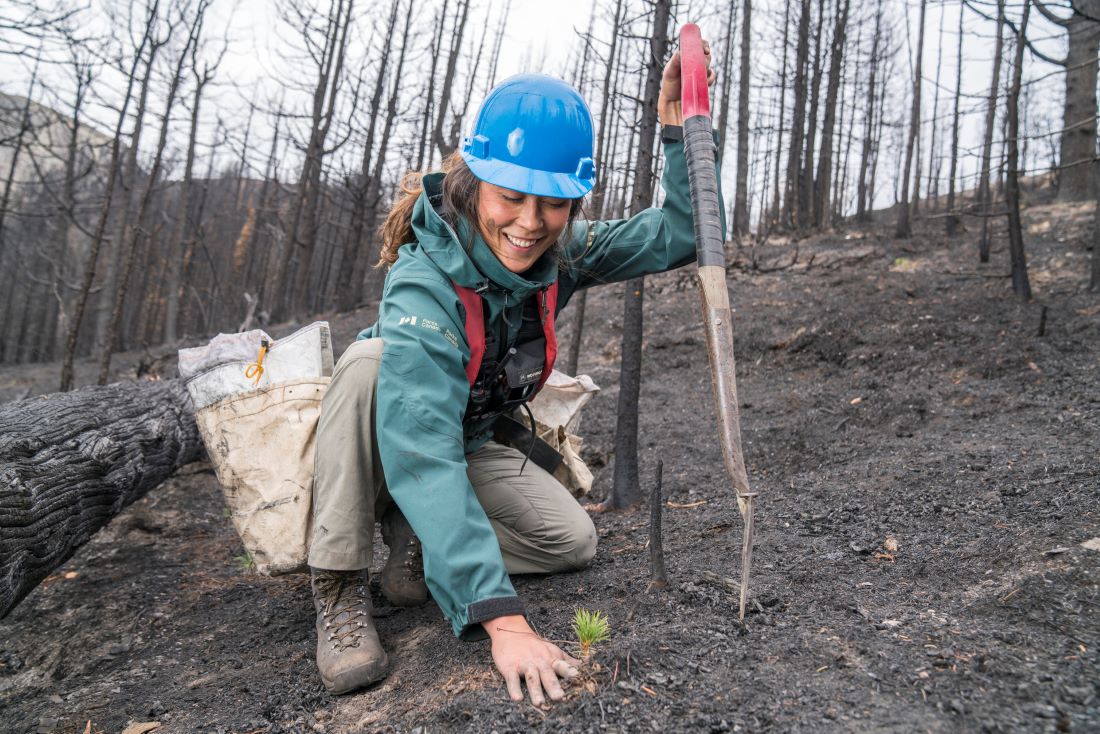
Since 2017, the park has planted more than 8,000 seedlings in several locations, focusing on areas recently impacted by wildfires where the regenerating Whitebark Pine will find ideal growing conditions with limited competition from other species.
Long description of image
This is a photograph of a Parks Canada employee planting a Whitebark Pine seedling in the Verdant Creek burn, Kootenay National Park. The employee is crouching down on the ground, over bare, burnt soil. The background is bare, burnt trees.
4. Ecological impacts
Ecological impacts of the action plan are assessed by measuring progress towards meeting the site-based population and distribution objectives described in the action plan (Table 2). See the original action plan for national Population and Distribution Objectives (where available) and General Information and Broad Park Approach for each species. A more detailed description of progress made towards the site-based population and distribution objectives for Whitebark Pine is outlined in Appendix A.
| Species | Site-based population & distribution objectives | Population monitoring | Progress towards site-based population and distribution objectives | Progress (% achieved) |
|---|---|---|---|---|
| American Badger (jeffersonii) | To maintain/increase adequate amount of suitable badger habitat within the park, as part of supporting a goal to ensure a viable population of badgers throughout their historic range in B.C. | 1. Hectares of currently closed forest on suitable soils that are restored/enhanced to open forest/grassland habitat areas. 2. Level of protection from harassment/mortality by a) increasing patrols/education re: dogs on leash at Redstreak and Sinclair and other restored areas. b) enforcing SARA provisions on federal Crown lands. 3. Support for local/regional conservation initiatives having potential to increase badger presence in the park. 4. Number of badger road mortalities. |
Parks Canada set an objective of 250 hectares of restored badger habitat with an existing baseline of 200 hectares. The current amount of restored badger habitat is 240 hectares. | 80% |
| Whitebark Pine | To establish a self-sustaining, rust-resistant population of Whitebark Pine throughout the species' range in the park that demonstrates natural seed dispersal, connectivity, genetic diversity and adaptability to changing climate. | 1. Disease infection, stand density and mortality rate via stand health transects. 2. Hectares of habitat created or restored. 3. Number of potentially resistant trees identified and protected and number of these with stored seeds. 4. If fire is applied, the amount of regeneration 5-years post-fire. |
Whitebark Pine condition continues to decline. Stand health transects conducted in 2019 showed an increasing trend of blister rust infection compared to 2014. Recovery actions have been applied across the park including habitat creation and restoration, identification and protection of potentially rust-resistant trees, seed collection and storage, and planting of Whitebark Pine in high quality habitat. See Appendix A for more detailed information. |
32% |
5. Socio-economic impacts
The Species at Risk Act requires the responsible federal minister to report on the socio-economic costs of the multi-species action plan and the benefits derived from its implementation. The multi-species action plan only applies to protected lands and waters under the authority of the Parks Canada Agency, which are often subject to fewer threats (e.g., industrial activities) compared to other areas, as the lands are managed to preserve ecological and commemorative integrity. This section does not include socio-economic impacts of existing permitted activities that may be occurring in Parks Canada places as those have been addressed through other processes (e.g.: impact assessments). This socio-economic assessment is narrow in scope, as it is focused on the measures implemented within the action plan, and primarily focuses on Indigenous partners, leaseholders, licensees, residents and visitors. The overall socio-economic impacts of the multi-species action plan for Kootenay National Park, described as costs and benefits, are outlined below.
Costs
Most costs to implement this action plan were borne by Parks Canada out of existing salaries and goods and services dollars. This includes incremental salary costs, materials, equipment, and contracting of professional services for measures outlined in Appendix B (Conservation and recovery measures that will be conducted in Kootenay National Park) of the action plan. Additional resources were provided by the University of Calgary to support graduate student research and inventories for bats in the park, including Little Brown Myotis.
No major socio-economic costs to partners, stakeholders or Indigenous groups resulted from this action plan. The recovery measures were integrated into the operational management of Kootenay National Park. These costs were covered by prioritization of existing funds and salary dollars and did not result in additional costs to society.
The action plan applies only to lands and waters in Kootenay National Park, several adjacent parcels of federal Crown land administered by Parks Canada, and Kootenae House National Historic Site. There were no restrictions to land use outside these federal properties.
This action plan, therefore, did not result in any significant socio-economic impacts to the public. Only one new temporary restriction on visitor activities was implemented on regulated lands to protect and recover species at risk – a small parking lot and an adjacent natural area in the Redstreak Restoration Area were temporarily closed to visitor use during summer 2020 to protect an American Badger maternity den.
Benefits
Measures presented in the action plan for Kootenay National Park contributed to meeting recovery strategy objectives for Threatened and Endangered species. These measures had an overall positive impact on ecological integrity and enhanced opportunities for appreciation of the sites and the species by visitors and the general public. Kootenay National Park is working with partners to incorporate Indigenous knowledge into recovery programs. This is anticipated to yield additional benefits for species at risk in the future. The action plan included measures that likely resulted in benefits to Canadians, such as positive impacts on biodiversity and the value individuals place on preserving native species and ecosystems.
The measures sought a balanced approach to reduce or eliminate threats to at-risk populations and habitats, and included protection of individuals and their habitat (e.g., restrictions to human activities within areas occupied by the species, combined with ongoing research and monitoring), species re-establishment, and increasing public awareness and stewardship. For example, putative rust-resistant Whitebark Pine seedlings have been planted in the park, and an active American Badger den was protected by temporarily closing a small area to visitor use. Communication products focused on protecting Little Brown Myotis were also produced and distributed in the park.
Potential economic benefits of the recovery of the species at risk found in the park cannot be easily quantified, as many of the values derived from wildlife are non-market commodities that are difficult to appraise in financial terms. Wildlife, in all its forms, has value in and of itself, and is valued by Canadians for aesthetic, cultural, spiritual, recreational, educational, historical, economic, medical, ecological and scientific reasons. The conservation of wildlife at risk is an important component of the Government of Canada's commitment to conserving biological diversity, and is important to Canada's current and future economic and natural wealth.
Maintaining healthy ecosystems and a full range of native biodiversity is a key component of visitor experience in Kootenay National Park. Wildlife viewing is one of the most common visitor activities in the park and this helps support the economic health of the communities in the area.
Implementation of this action plan has provided new opportunities for park visitors to learn about species at risk through interpretive programming and various communication products. Local residents and businesses have been provided information on how they can contribute to the recovery of species at risk. The park has also engaged urban audiences with outreach programing in Calgary and in Vancouver that includes content on species at risk. Kootenay National Park is building relationships with Indigenous partners that will provide opportunities to incorporate traditional knowledge into species recovery measures.
Summary
The recovery measures in the action plan had limited socio-economic impact and placed no restrictions on land outside the boundary of the national park, adjacent federal lands and Kootenae House National Historic Site. Direct costs of implementing this action plan were borne primarily by Parks Canada. Indirect costs were minimal, while benefits included positive impacts on park ecological integrity, greater awareness of species and enhanced opportunities for engagement of visitors and local communities.
Appendix A. Technical Compendium – Population and Distribution Objectives
Whitebark Pine
The following table supports the summary population and distribution progress statements in Table 2.
| Species | Site-based population & distribution objectives | Population monitoring | Progress towards site-based population and distribution objectives | Progress (% achieved) |
|---|---|---|---|---|
| Whitebark Pine | To establish a self-sustaining, rust-resistant population of Whitebark Pine that demonstrates natural seed dispersal, connectivity, genetic diversity and adaptability to changing climate. | 1. Disease infection, stand density and mortality rate via stand health transects. |
Whitebark Pine condition continues to decline. Blister rust infection rates for live trees increased from 44% in 2003 to 59% in 2019; this rate remains moderate compared with most areas of Whitebark Pine habitat. Stand density of cone producing trees is 11.2 m2 per hectare which is good (<2 m2 is poor). This means that natural regeneration is still occurring. |
0% |
| 2. Hectares of habitat created or restored. | Over 8,000 seedlings have been planted since 2017 and more than 20,000 seeds have been collected. Based on recent restoration plans for similar areas, it is likely that 100,000 seedlings may be required to meet long-term objectives. | 8% | ||
| 3. Number of potentially resistant trees identified and protected and number of these with stored seeds. | Thirty-four potentially resistant trees have been identified, and 17 of these trees are in blister rust resistance testing programs. Early results indicate that two trees have resistance while three trees are not resistant. Progress is measured based on the Open Standards draftFootnote 8.
|
20% |
||
| Kootenay National Park has not experienced a significant mountain pine beetle outbreak in the past 5 years, and pheromones have been applied annually to protect high value trees. All of the 34 (100%) plus trees are still alive. | 100% | |||
| 4. If fire is applied, the amount of regeneration 5-years post-fire. | Prescribed fire has not yet been applied for Whitebark Pine restoration. Mechanical thinning has been completed in 0.5 hectares which is a small area relative to the amount of Whitebark Pine habitat. | Not reportable | ||
| Overall progress is calculated as an average of the four monitoring components. | Overall 32% |
A monitoring program began in 2003 to measure the condition of Whitebark and Limber Pine in the Canadian Rocky and Columbia Mountains. Permanent plots from the Canada-United States border to the Willmore Wilderness in the north have been re-measured every 5-years. The data about blister rust infection levels, tree mortality and natural regeneration helps direct restoration action across national parks, provincial parks, and Alberta and British Columbia provincial lands. While these data are important, Whitebark Pine is very slow-growing, and it will take many decades for this type of population monitoring to respond to restoration action such as seed collecting, seedling planting, or prescribed fire.
Since the Action Plan was written, restoration experts have identified goals to measure progress to meet population and distribution objectives for Whitebark Pine recoveryFootnote 9. The approach, which can be refined for a region, recommends a network of "component populations" that consist of >5,000 mature parent trees located within 12 km of another component population (within 30% of the species' regional range). Given existing seedling survival estimates (~50%), roughly 10,000 putatively resistant seedlings should be planted in each component population. This approach synthesizes the best available datasets and science into a flexible, data-informed decision-making process that can be applied consistently across large geographic areas, and importantly, we can measure progress toward recovery. In future, monitoring the condition of "component populations" may be identified as the best approach to measure progress toward meeting population and distribution objectives.

Text description
This is a photograph of A Parks Canada employee planting a Whitebark Pine seedling on a steep mountain slope.
This is a photograph is a close-up image of a small Whitebark Pine seedling on a vegetated slope. There are mountains in the distant background.
- Date modified :