Implementation Report: Multi-species Action Plan for Pukaskwa National Park of Canada (2017-2022)

Long description for cover image
The cover page is a series of 7 photos arranged in clockwise order. The first photograph shows an aerial panorama of Pukaskwa National Park's front country coastline, centered on the Southern Headland Trail. The rugged, rocky headlands, blanketed by boreal forest, are exhibited clearly, with sandy Horseshoe Beach visible at centre and Pukaskwa's Middle and North beaches visible to the left. Lake Superior's blue waters make up the foreground. In the second photograph, a woodland caribou searches for something edible on a fallen tree trunk. The caribou's head is tilted, with one eye and a pair of antlers visible. Other fallen trees lay on the forest floor. The third photograph shows a perspective view of Chigamiwinigum Falls, taken from above the White River. Swirling, white-water rapids are visible, with large boulders and rocks protruding from the river. Dense conifers grow near the top of the granite walls. In the fourth image, a Peregrine Falcon is shown in flight against a matte white background. With its wings fully extended, the Peregrine Falcon's brown feather pattern is seen, with white highlights particularly evident on the tail feathers and tips of the wings. In the fifth photograph, a bat (Myotis sp.) flies under the ceiling of a rocky cavern. The wings of the Myotis sp. are fully extended, and the bone structure of the wings is clear. Image six shows a Common Nighthawk perched on a dry, dead tree branch. The Common Nighthawk's outer feathers are speckled brown, white, and black, and longer greyish brown tail feathers are visible in this image. In the final photograph, a winged insect rests on the light pink flower of a Pitcher's Thistle. The thistle has three heads at the top of its pale green stem, only one of which has flowered. The sandy coastal habitat from which the Pitcher's Thistle grows is visible in the image.
On this page
- Preface
- Acknowledgments
- Executive Summary
- 1. Context
- 2. Implementation of the action plan
- 3. Action plan highlights
- 4. Ecological impacts
- 5. Socio-economic impacts
Document information
Recommended citation:
Parks Canada Agency. 2022. Implementation Report: Multi-species Action Plan for Pukaskwa National Park of Canada (2017 – 2022). Species at Risk Act Action Plan Series. Parks Canada Agency, Ottawa. v + 16 pp.
For copies of the report, or for additional information on species at risk, including the Committee on the Status of Endangered Wildlife in Canada (COSEWIC) Status Reports, residence descriptions, recovery strategies, action plans and other related recovery documents, please visit the please visit the Species At Risk Public RegistryFootnote 1.
Photo Credits:
All photos, unless otherwise stipulated are copyright of Parks Canada.
Cover illustrations, clockwise from top left: Southern Headland Trail; Woodland Caribou, Jack Illingworth; White River; Peregrine Falcon; Flowering Pitcher's Thistle with a Syrphid; Common Nighthawk; Myotis sp., Brock Fenton Page 8: Parks Canada staff conducing a Pitcher's Thistle count survey.
Également disponible en français sous le titre
« Rapport de mise en œuvre : Plan d'action visant des espèces multiples dans le parc national du Canada Pukaskwa (2017-2022) »
© Her Majesty the Queen in Right of Canada, represented by the Minister of Environment and Climate Change, Year. All rights reserved.
ISBN: to come
Catalogue no. to come
Content (excluding the illustrations) may be used without permission, with appropriate credit to the source.
Preface
The federal, provincial, and territorial government signatories under the Accord for the Protection of Species at Risk (1996)Footnote 2 agreed to establish complementary legislation and programs that provide for effective protection of species at risk throughout Canada. Under the Species at Risk Act (S.C. 2002, c.29) (SARA), action plans outline measures that will be taken to implement recovery strategies for SARA-listed Extirpated, Endangered and Threatened species. Parks Canada's multi-species action plans address a suite of species of conservation concern within one or more Parks Canada managed areas, including species that require an action plan under SARA.
The Minister responsible for the Parks Canada Agency (the Minister of the Environment and Climate Change) is the competent minister under SARA for species found in Pukaskwa National Park of Canada, and in 2017 published the Multi-species Action Plan for Pukaskwa National Park of Canada.
Under section 55 of SARA, the competent minister must monitor the implementation of an action plan and the progress towards meeting its objectives, and assess and report on its implementation and its ecological and socio-economic impacts five years after the action plan comes into effect. A copy of the report must be included in the Species at Risk Public Registry. The Minister responsible for the Parks Canada Agency has prepared this Implementation Report: Multi-species Action Plan for Pukaskwa National Park of Canada (2017-2022).
The achievement of population and distribution objectives identified within the recovery strategy or management plan for a species may require a long time frame. In these cases, a five-year reporting window may not be sufficient to show demonstrable progress towards meeting site-based population and distribution objectives identified for that species within a Parks Canada site-based action plan. Parks Canada monitors, evaluates and, as necessary, adapts measures taken to achieve species survival or recovery, and will report on progress towards meeting site-based population and distribution objectives every five years.
Acknowledgments
Parks Canada would also like to acknowledge those who have contributed to the implementation of the Multi-species Action Plan for Pukaskwa National Park of Canada.
Numerous partners and individuals provided expertise and assistance in the implementation of the action plan. Thanks are extended to individuals from: Anishinabek/Ontario Fisheries Resource Centre; Myotistar; Natural Resource Canada; Environment and Climate Change Canada; Ontario Ministry of Natural Resources and Forestry; Department of Fisheries and Oceans Canada; Biigtigong Nishnaabeg; Project Peregrine – Thunder Bay Field Naturalists; Trent University – Natural Resources DNA Profiling & Forensic Centre; and United States Fish and Wildlife Service.
In addition to the above partners, we would like to acknowledge the contributions of every person who visits Pukaskwa National Park. From avid volunteers who participate in our work, to campers and hikers who seek to learn more about the land and its history. Every visitor takes away precious memories and a greater appreciation for natural systems and wildlife, thereby contributing to goals of conservation for future generations.
Thank you, Merci, Miigwech.
Executive Summary
This document reports on implementation of the Multi-species Action Plan for Pukaskwa National Park of Canada between 2017 and 2022. It reports on implementation of measures identified in the plan, assesses progress towards meeting site-based population and distribution objectives, and evaluates socio-economic impacts.
Species AddressedFootnote 3
The action plan addressed 13 SARA-listed species and two species of conservation concern. Measures and site-based population and distribution objectives identified within the action plan were focused on 6 species, for which management actions within Pukaskwa National Park could have a substantive impact on species survival or recovery: Canada Warbler, Common Nighthawk, Olive-sided Flycatcher, Peregrine Falcon, Lake Sturgeon, and Pitcher's Thistle.

Long description of diagram
This diagram shows a thick ring that is segmented into sections. Each section of the ring reflects a category of SARA classification, and is weighted in size based on the number of species in each category. The total number of species included in this report is reflected by a number in the middle of the ring. The diagram shows 15 total species, including 1 Endangered species, 6 Threatened species, 6 Special Concern species, and 2 non-SARA listed species of conservation concern.Footnote 4
Implementation of the action plan
8 measures (recovery actions) were identified in the multi-species action plan. Implementation of the action plan is assessed by determining progress towards completing each measure, and is outlined in Section 2 of this report. During the five-year period, all committed measures were initiatedFootnote 5 and completed. An additional 8 measures were identified in the action plan if resources and/or partnerships became available to support the work. Resources became available for 5 measures.

Long description of diagram
This diagram shows two separate, thick rings. One ring shows that 100% of the measures in the action plan have been initiated and the other ring shows that 100% of the measures have been completed.
Ecological impacts
Site-based population and distribution objectives (PDOs) were developed for 6 species in the action plan. Ecological impacts are assessed by measuring progress towards achieving each of the site-based population and distribution objectives and are outlined in section 4. Progress was made on objectivesFootnote 6 for 3 species including 2 species for which the objectives were fully met.

Long description of diagram
This diagram shows two thick rings. One ring shows that 50% of the Population and Distribution Objectives were partially achieved, while the other ring shows that 33% of the Population and Distribution Objectives were fully achieved.
Socio-economic Impacts
Direct costs of implementing this action plan were borne by Parks Canada. Indirect costs were mainly through minor visitor restrictions to certain areas of the park to protect Pitcher's Thistle colonies. Benefits included positive impacts on park ecological integrity, greater awareness of species and enhanced opportunities for engagement.

Long description of diagram
This diagram shows three circles overlapping with one another in an upside-down triangle shape. Each circle has text in the middle. The top left circle says "Environmental", the top right circle says "Social", and the bottom circle says "Economic".
1. Context
This document reports on implementation of the Multi-species Action Plan for Pukaskwa National Park of CanadaFootnote 7 between 2017 and 2022, assesses progress towards meeting its population and distribution objectives, and evaluates its socio-economic impacts. It addresses 15 species, including 7 SARA-listed Endangered and Threatened species (for which an action plan is required) as well as 6 SARA-listed Special Concern speciesFootnote 8. Lake Sturgeon (Great Lakes – Upper St. Lawrence) and Shortjaw Cisco are included in this action plan as they are species of conservation concern.
Site-based population and distribution objectives were developed for 6 species for which implementation measures within Pukaskwa National Park could have a substantive impact on recovery: Canada Warbler, Common Nighthawk, Olive-sided Flycatcher, Peregrine Falcon, Lake Sturgeon, and Pitcher's Thistle.
2. Implementation of the action plan
Implementation of the Multi-species Action Plan for Pukaskwa National Park of Canada is assessed by measuring progress towards completing the recovery measures identified in the action plan (Table 1). Refer to the original action plan for a description of each measure, the desired outcomes, and the threats that each measure addresses.
In 2020 and 2021, there were several restrictions put in place at Pukaskwa National Park to combat the spread of COVID-19, including temporary restriction of park management activities. This impacted the ability of the park to complete the implementation of some parts of the action plan. For example, restrictions directly affected the park's ability to complete live-trapping surveys for Snapping Turtles.
|
Species and measure |
Desired outcome |
Progress towards outcome |
Progress (% complete) |
|---|---|---|---|
|
1) Pitcher's Thistle: Add new sites, increase the total number of plants, and ensure acceptable population fluctuations in Pukaskwa. |
By 2021, two new sites have been seeded, total number of plants is at least 800 with populations not exhibiting long-term declines. |
Two new restoration sites (Oiseau Creek and Tombolo) were established and seeded at Oiseau Bay in 2013 in response to the objectives in the Recovery Strategy. Both sites were repeatedly reseeded between 2017 and 2021 until the first flowering plants were observed at both sites in 2021 (Oiseau Creek: 2020 and 2021; Tombolo: 2017, 2018, 2020 and 2021). There were 1,476 plants in total in 2021 at the four monitored sites within the Hattie Cove and Oiseau Bay populations. The long-term regional population trend is stable for Hattie Cove and increasing for Oiseau Bay. |
100%* |
|
2) Woodland Caribou |
Information on the genetic similarity of animals occurring in Pukaskwa to surrounding animals is known by 2017. |
Completed genetic analysis in collaboration with Environment and Climate Change Canada and OMNRF by 2017. Woodland Caribou samples from Pukaskwa National Park were compared to a regional database of genetic samples to assess linkages within and beyond the Lake Superior Coastal Range. Results were published in Drake et al. (2018)Footnote 9. |
100% |
|
3) Woodland Caribou |
Historical calving habitat is monitored annually using wildlife cameras. |
Historical calving habitat were monitored annually at five coastal locations using wildlife cameras. No Woodland Caribou were observed. |
100%* |
|
4) Woodland Caribou |
Protect critical habitat in the Park. |
Between 2017 and 2021, no prescribed fires occurred in critical habitat, and a natural wildland fire within critical habitat was extinguished during the summer of 2021 with assistance from the Ministry of Northern Development, Mines, Natural Resources, and Forestry. |
100%* |
|
5) Woodland Caribou |
Visitors to Pukaskwa National Park will have an understanding of caribou status and reasons for population declines on an ongoing basis. |
A permanent bronze statue series, featuring a caribou, wolf and moose, was installed in 2013 outside of the Visitor Centre. Information on caribou status and reasons for population declines were communicated to visitors using articles in the visitor guide (2017 – 2018) and children's activity booklet (2015 – 2019). |
100%* |
|
6) All species: Encourage staff and visitors to record and report incidental sightings of species at risk (and share with Ontario Natural Heritage Information Centre and Fisheries and Oceans Canada). |
Incidental sightings are reported annually to Ontario's Natural Heritage Information Centre and Fisheries and Oceans Canada. |
A total of 12 different species at risk were observed in Pukaskwa National Park between 2017 and 2021. As of 2022-03-24, 682 individual species records were reported to Ontario's Natural Heritage Information Centre. |
100%* |
|
7) Peregrine Falcon anatum/tundrius: Engage paddlers with a citizen science program to contribute to annual monitoring program. |
Citizen science program in place with annual contributions being made by visitors or volunteers. |
Implemented the Peregrine Falcon Citizen Science Project in 2017. Produced an information pamphlet and encouraged coastal paddlers to share sightings. A total of 15 potential Peregrine Falcon observations were reported by six participants since the program's inception. |
100%* |
|
8) Little Brown Myotis: Display audio recorder with information panel at Visitor Centre for education and awareness on declines of bats. |
Bat audio recording device displayed and information available to visitors on the importance of bats to people, ecosystem, biodiversity and economies. |
A species at risk bat exhibit and citizen science pamphlets were displayed at the Visitor Centre in 2021. Ultrasonic acoustic recorders with interpretive signage were displayed at six different locations along frontcountry and backcountry trails from 2019 – 2020 and at two frontcountry locations in 2021. Little Brown Myotis was identified at all stations in all years. |
100%* |
Additional measures were identified in the action plan that would be beneficial to complete should resources become available. Table 2 describes the actions that Pukaskwa National Park was able to initiate between 2017 and 2022. Measures from the action plan that were not initiated will be considered in the next action plan.
| Species and measure |
Desired outcome |
Progress towards outcome |
Progress (% complete) |
|---|---|---|---|
|
9) Pitcher's Thistle: Develop and install interpretive signage about the Pitcher's Thistle restoration project. |
Interpretive signs are installed at two Pitcher's Thistle populations in Pukaskwa National Park. |
Interpretive signs were installed in 2018 at two Pitcher's Thistle colonies (Oiseau Creek and Middle Beach). |
100% |
|
10) Pitcher's Thistle: Enhance knowledge of dune ecosystem impairment and restore dune ecosystem if necessary |
Evidence that dune ecosystems have been impaired as a result of change in driftwood and subsequent restoration if warranted. |
A driftwood and open sand classification and analyses report was completed in 2019. A dune ecosystem restoration literature review was completed in 2021. Based on the information from the analyses and report, restoration was deemed not to be warranted at this time. |
100%* |
|
13) Peregrine Falcon anatum/tundrius: Band Peregrine Falcon nestlings and deliver national media pitch to increase awareness. |
Research and monitoring support of National Peregrine Falcon recovery goals and Canadians have an increased understanding of Peregrine Falcon. |
Peregrine Falcon nestlings were banded in 2018 in collaboration with Project Peregrine – Thunder Bay Field Naturalists. Canadians were made aware of the project through updated web content on Pukaskwa National Park's and Parks Canada's websites, news articles, and scientific publications. |
100% |
|
14) Snapping Turtle: Conduct surveys in suitable habitat to confirm if species occurs regularly in the park |
Occurrences/range in Pukaskwa National Park is known |
Conducted a distribution survey using environmental DNA (eDNA) at coastal and interior locations in Pukaskwa National Park. No Snapping Turtles were detected from a total of 103 eDNA samples taken from 35 locations within 11 lakes or streams. However, live-trapping did not occur. |
66%* |
|
16) All species at risk: Create a species at risk mobile exhibit (i.e. interactive sign that features SAR birds, sounds or similar), as well as ways to report incidentals sightings, that can be on display at the Visitor Centre or elsewhere (i.e. schools, etc.). |
An exhibit or similar material is available related to species at risk in Pukaskwa National Park is available in Pukaskwa and other engagements. |
A species at risk mobile exhibit, to take to off-site events, was created in 2020 by the Northern Ontario Field Unit. The exhibit includes interactive digital information, engaging games, podium, banners, and graphics to inform visitors about citizen science and protecting species at risk. The mobile exhibit is available for display at the Park Visitor Centre when not in use elsewhere. From 2020 – 2021, 5679 visitors had opportunities to view and learn from the species at risk mobile exhibit. |
100%* |
3. Action plan highlight
Pitcher's Thistle Restoration
Pukaskwa National Park's unique coastal dune habitat is home to the northernmost populations of Pitcher's Thistle in Canada. To ensure this unique species will survive for generations to come, the park implemented a restoration project in 2013 that is ongoing today. This project involves two key components: species recovery and public education.
The Pitcher's Thistle restoration project includes a visitor centre exhibit, interpretive signage, exclusion rope to protect sensitive dune habitat and plants, continued annual monitoring, assisted seed dispersal at two restoration colonies, and use of an unmanned aerial vehicle to accurately map colony extent.
The park met national objectives by continuing to maintain the Oiseau Bay and Hattie Cove populations, and exceeded site objectives (800 plants by 2021) by reaching a total of 1,476 plants in 2021 at four sites. Furthermore, three flowering plants were counted for the first time in 2021 at the Oiseau Bay restoration colonies, marking a possible turning point towards two new self-sustaining colonies.
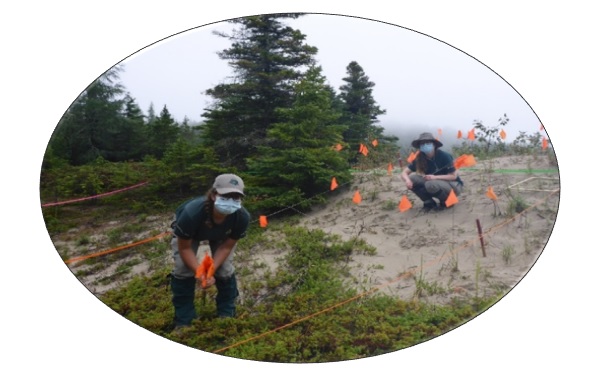
Long description of image
In this photograph, two of Pukaskwa National Park's Resource Conservation staff members monitor the population of Pitcher's Thistle (Cirsium pitcheri) at the Park's Middle Beach colony. The day is foggy, and the two Resource Conservation team members work on a sand dune supported by green vegetation and conifer trees. Five metre by five metre plots, constructed of orange, green, and pink flagging tape, are used to isolate sections of the colony. Individual Pitcher's Thistles are marked with a small orange flag.
4. Ecological impacts
Ecological impacts of the action plan are assessed by measuring progress towards meeting the site-based population and distribution objectives described in the action plan (Table 3). See the original action plan for national Population and Distribution Objectives (where available) and General Information and Broad Park Approach for each species.
| Species |
Site-based population & distribution objectives |
Population monitoring |
Progress towards site-based population and distribution objectives |
Progress (% achieved) |
|---|---|---|---|---|
|
Canada Warbler Common Nighthawk Olive-sided Flycatcher |
Increase the total area of breeding habitat using fire. |
Because the park is so inaccessible, monitoring populations is not feasible, therefore a habitat surrogate will be used. Total breeding habitat will be measured every 5 years. |
Weather conditions did not allow for the use of prescribed fires to increase breeding habitat. One planned prescribed fire at Perry Lake is ready to be initiated as soon as conditions allow, and once complete, will contribute to this goal. Plans for future prescribed fires are ongoing. |
0% 0% 0%
|
|
Peregrine Falcon (anatum/ tundrius) |
|
1 – 2. Annual monitoring at each historically occupied territory and new territories as they arise. |
|
100% |
|
|
|
||
|
Pitcher's Thistle |
|
1 -3. Number of plants tallied each year (by rosette, seedling, or flowering plant) per plot in each colony. |
|
92% |
|
|
|
||
|
|
|
||
|
Lake Sturgeon |
Rehabilitate spawning populations so they become self-sustaining as per the Lake Superior Cooperative Science & Monitoring program goals (Pratt et al. 2016) Footnote 10 |
Catch per unit effort (number/305m gillnet) |
The Lake Superior Technical Committee proposed, as a possible threshold for a self-sustaining Lake Sturgeon population, a geometric mean catch per unit effort (CPUE) for age class 4 – 8 of no less than 0.5. As part of the Cooperative Science and Monitoring Program's Lake Sturgeon project, geometric mean CPUE was measured for sturgeon of age class 4 – 8 cohort at the White and Pic Rivers combined in 2016 by DFO, and in 2021 by the Anishinabek/Ontario Fisheries Resource Centre. Geometric mean CPUE for the 4 – 8 age cohort was above the 0.5 threshold in both 2016 (0.63) and 2021 (1.84). |
100% |
5. Socio-economic impacts
The Species at Risk Act requires the responsible federal minister to report on the socio-economic costs of the multi-species action plan and the benefits derived from its implementation. The MSAP only applies to protected lands and waters under the authority of the Parks Canada Agency, which are often subject to fewer threats (e.g., industrial activities) compared to other areas as the lands are managed to preserve ecological and commemorative integrity. This section does not include socio-economic impacts of existing permitted activities that may be occurring in Parks Canada places as those have been addressed through other processes (e.g., impact assessments). This socio-economic assessment is narrow in scope, as it is focused on the measures implemented within the action plan, and primarily focuses on Indigenous partners, leaseholders, licensees, residents and visitors. The overall socio-economic impacts of the multi-species action plan for Pukaskwa National Park, described as costs and benefits, are outlined below.
Costs
The majority of costs to implement this action plan were borne by Parks Canada out of existing salaries and goods and services dollars. This includes incremental salary costs, materials, equipment, and contracting of professional services for measures outlined in Appendix B (Conservation and recovery measures that will be conducted by Pukaskwa National Park) and Appendix C (Other recovery measures that will be encouraged through partnerships or when additional resources become available) of the action plan. No major socio-economic costs to partners, stakeholders or Indigenous groups were incurred as a result of this action plan. Additional resources and partnership were provided by:
- Project Peregrine – Thunder Bay Field Naturalists helped band Peregrine Falcon chicks in 2018
- The Anishinabek/Ontario Fisheries Resource Centre conducted the third 5-year cycle of the Lake Sturgeon Index Survey in Pukaskwa National Park in 2021
- Environment and Climate Change Canada and the Ontario Ministry of Natural Resources and Forestry collaborated with Pukaskwa National Park on the assessment of Woodland Caribou genetics in the park and the Lake Superior region
Action plan measures were integrated into the operational management of Pukaskwa National Park and did not result in extra costs over the 5 years. These costs to the Parks Canada Agency were covered by prioritization of existing funds and salary dollars and did not result in additional costs to society.
The action plan applies only to lands and waters in Pukaskwa National Park, and did not bring any restrictions to land use outside the national park. As such, this action plan placed no additional socio-economic costs on the public. However, some restrictions were placed on visitors to Pukaskwa National Park. To protect and recover Pitcher's Thistle colonies, exclusion rope was installed with interpretive signage along a portion of Middle Beach and Oiseau Creek to prevent visitor travel from damaging sensitive dune habitat. In addition, national park staff temporarily restricted access to all Pitcher's Thistle colonies while unmanned aerial vehicle imagery was being collected each summer.
Benefits
Measures presented in this action plan for Pukaskwa National Park contributed to meeting recovery / population and distribution objectives for Threatened and Endangered species, and also contributed to meeting management objectives for species of Special Concern. The measures sought a balanced approach to reducing or eliminating threats to at-risk populations and habitats, and included protection of individuals and their habitat (e.g., restrictions to human activities within areas occupied by the species, combined with ongoing research and monitoring), species restoration, and increasing public awareness and stewardship (e.g., signage, visitor programs, and highlights in communication media).
These measures had an overall positive impact on ecological integrity via protection of individuals and their habitats, and enhanced opportunities for appreciation of the sites and the species by visitors and the general public. Working with partners, staff contributed to building awareness on the decline of Little Brown Myotis populations affected by white-nose syndrome as well as building an awareness of the importance of monitoring to inform conservation priorities in Pukaskwa National Park, Canada and North America. Data and information collected from bat monitoring were shared with the North American Bat Monitoring Program to advance species conservation research, protection and planning. Measures taken as part of the action plan also provided benefits to other species of conservation concern that occur in Pukaskwa National Park such as habitat protection for Woodland Caribou. This action plan included measures that likely resulted in benefits to Canadians, such as positive impacts on biodiversity and the value individuals place on preserving biodiversity.
Potential economic benefits of the recovery of the species at risk found in Pukaskwa National Park cannot be easily quantified, as many of the values derived from wildlife and plants are non-market commodities that are difficult to appraise in financial terms.
Wildlife, in all its forms, has value in and of itself, and is valued by Canadians for aesthetic, cultural, spiritual, recreational, educational, historical, economic, medical, ecological and scientific reasons. The conservation of wildlife at risk is an important component of the Government of Canada's commitment to conserving biological diversity, and is important to Canada's current and future economic and natural wealth.
Implementing this action plan had positive benefits for park visitors, local residents, and Indigenous Peoples. Pukaskwa National Park welcomed a total of 63,376 visitors between 2017 and 2021, many of whom had visitor experience opportunities relating to the education and awareness of species at risk in the park. In 2018 and 2019, Pukaskwa National Park hosted public BioBlitz events to help collect valuable ecological species data, but also to create opportunities for meaningful experiences connecting people with nature and Parks Canada places. These efforts generated a total of 131 participants with over 200 species identified and submitted to citizen science programs such as iNaturalist and the Ontario Natural Heritage Information Centre. In 2020, a species at risk mobile exhibit was developed to provide educational opportunities on Pukaskwa National Park's species at risk outside of the park. The exhibit was presented at two events in February 2020, with an estimated reach of 1050 individuals. In 2021, the exhibit was displayed at Pukaskwa National Park's Visitor Centre, where 4629 individuals had the opportunity to view the exhibit. Learning and work opportunities were supported with Biigtigong Nishnaabeg by involving a Band student to help with species at risk recovery and monitoring in Pukaskwa National Park.
Summary
Direct costs of implementing this action plan were borne by Parks Canada. Indirect costs were mainly through visitor restrictions to certain areas of the park to protect Pitcher's Thistle colonies. Benefits included positive impacts on park ecological integrity, greater awareness of species and enhanced opportunities for engagement.
- Date modified :